

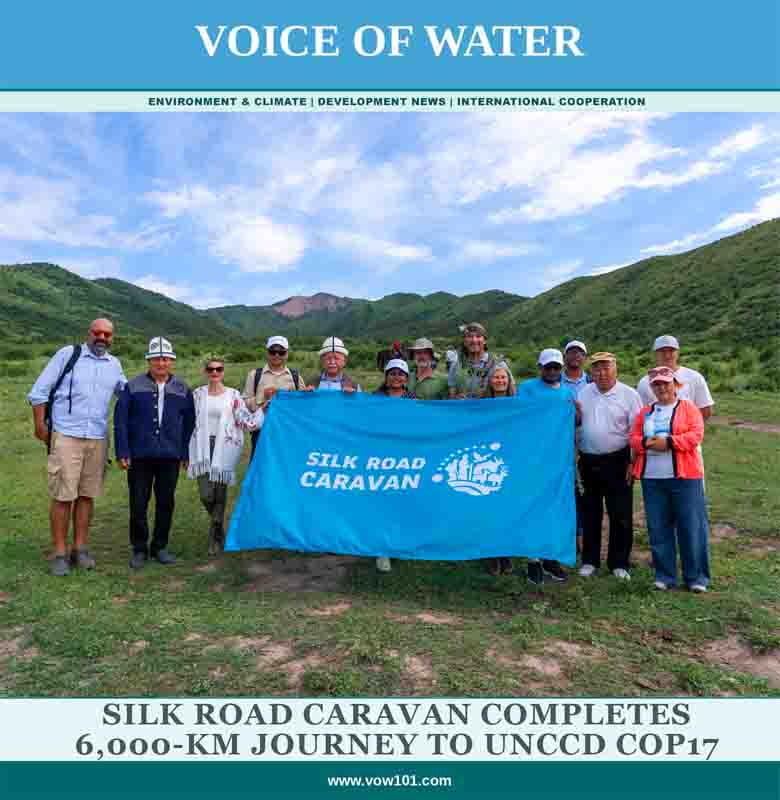
Silk Road Caravan Completes 6,000-Km Journey to UNCCD COP17
The UNCCD Silk Road Caravan reaches Mongolia after a 6,000-km journey across Eurasia, bringing pastoralist knowledge and rangeland restoration lessons to COP17.
Silk Road Caravan Completes 6,000-Km Journey Across Eurasia, Reaches UNCCD COP17 in Mongolia
Ulaanbaatar, Mongolia — August 17, 2026 — The UNCCD Silk Road Caravan has completed the final stage of its more than 6,000-kilometre journey across Eurasia, arriving in Mongolia to carry pastoralist voices and rangeland restoration experiences into the opening of the UNCCD COP17 negotiations in Ulaanbaatar. The Caravan’s arrival marks the symbolic conclusion of a months-long initiative connecting local land-restoration knowledge with global environmental policy.
Background
The Silk Road Caravan is a flagship outreach initiative of the United Nations Convention to Combat Desertification (UNCCD), launched in support of the International Year of Rangelands and Pastoralists 2026. Over the course of its journey, the Caravan connected pastoralists, researchers, policymakers, young people, and local communities across some of Eurasia’s most significant dryland landscapes, reviving the historic spirit of the Silk Road not as a trade route, but as a corridor for exchanging knowledge, culture, and practical restoration solutions.
The journey began in Türkiye in May 2026 and passed through the Russian Federation, Uzbekistan, Kazakhstan, Kyrgyzstan, and China before reaching Mongolia. According to UNCCD, the Caravan crossed the 6,000-kilometre mark in northern China on 17 July — exactly one month before COP17 opened in Ulaanbaatar. Along the way, participants visited restoration sites and met with communities working to protect rangelands and sustain livelihoods under mounting pressure from drought, erosion, and land degradation.
Rangelands cover more than half of the Earth’s land surface and support around two billion people worldwide, providing nearly 70 percent of global livestock feed. Yet up to half of the world’s rangelands are degraded or at risk, threatening biodiversity, food production, carbon storage, and rural livelihoods. The issue carries particular weight for Mongolia, where rangelands cover roughly 70 percent of national territory and support the livelihoods of approximately one-third of the population, even as nearly 77 percent of the country’s land is affected by degradation.
Lessons Gathered Across Eurasia
The Caravan placed strong emphasis on documenting practical, community-driven restoration solutions from each country along its route:
- China (Otindag Sandy Land): Willow branches woven into grids to stabilize shifting dunes, supported by monitoring, controlled livestock numbers, and community incentives
- Türkiye: Seasonal pastoral mobility to distribute grazing pressure and allow pastures to recover
- Russia (Kalmykia region): Drought- and desertification-resistant vegetation used to stabilize shifting sands and restore productive pasture
- Uzbekistan (Nurabad District): Drought-tolerant pistachio trees planted on degraded pastures, with local residents paid for planting and maintenance
- Kazakhstan: Integration of soil surveys, satellite imagery, GPS, and digital agricultural mapping to monitor pasture conditions
- Kyrgyzstan: Intergenerational knowledge-sharing between young people and elders around pastoral traditions
Together, these examples point to a shared lesson: land restoration succeeds when communities hold the authority, incentives, knowledge, and economic opportunities needed to protect their own land. UNCCD Executive Secretary Dr. Yasmine Fouad has emphasized that people remain at the heart of restoration, and that there is no single pathway to restoring degraded landscapes.
Arrival at a Critical Moment for COP17
The Caravan’s experiences arrive in Ulaanbaatar as UNCCD COP17 convenes from 17–28 August 2026 under the theme “Restoring Land, Restoring Hope.” The conference brings together governments, scientists, Indigenous Peoples, pastoralists, civil society, businesses, and international organizations to advance action on land restoration, drought resilience, water, rangelands, and food systems.
The timing carries added significance as COP17 coincides with the International Year of Rangelands and Pastoralists, giving Mongolia a prominent platform to elevate pastoral communities and rangeland ecosystems within global policy discussions. At COP16 in Riyadh, countries adopted the UNCCD’s first decision specifically devoted to rangelands, calling for stronger policies and investment, action against land conversion and overexploitation, and greater participation of pastoralists in land-management and tenure decisions. COP17 now offers an opportunity to move from recognition toward implementation.
Toward a “Green Silk Road”
The Caravan’s journey has also prompted broader reflection on what the historic Silk Road could represent in the 21st century. Where the original route connected markets and civilizations through trade, a modern “Green Silk Road” could connect countries around restoration, renewable energy, climate resilience, sustainable agriculture, water security, biodiversity, and low-carbon development — complementing existing Eurasian connectivity with environmental sustainability and community resilience.
The initiative demonstrates how environmental cooperation can itself function as a form of connectivity: a dune-stabilization technique developed in China can inform communities elsewhere, pastoral knowledge from Mongolia can shape policy in other dryland regions, and digital land-monitoring systems developed in Kazakhstan can support cross-border decision-making.
Conclusion
The Silk Road Caravan’s arrival in Mongolia marks the end of one journey and potentially the start of a larger one. Its 6,000-kilometre route has underscored that land degradation, desertification, and drought do not respect national borders — and that solutions shouldn’t either. As UNCCD COP17 brings the international community together in Ulaanbaatar, the challenge now is to transform the Caravan’s accumulated knowledge into concrete policies, financing, technology partnerships, and community-led restoration programmes. In Mongolia, where the historic Silk Road and living pastoral traditions converge, the message from the Caravan is clear: restoring land is not only an environmental imperative — it is an investment in people, prosperity, and the future of Eurasian connectivity.