
Ladybird Beetles Help Balochistan Farmers Fight Pests Naturally
IWMI and BUITEMS trial ladybird beetles as a chemical-free pest control method in Balochistan, cutting aphid populations by 47% and boosting tomato yields 20%.
Ladybird Beetles Offer Balochistan Farmers a Chemical-Free Weapon Against Crop Pests
Bostan Pishin, Balochistan — September 2026 — A small, spotted insect is helping farmers in Pakistan’s Balochistan province fight back against destructive crop pests without using a single drop of chemical pesticide. A pilot initiative led by the International Water Management Institute (IWMI) in collaboration with the Balochistan University of Information Technology, Engineering and Management Sciences (BUITEMS) has shown that releasing seven-spotted ladybird beetles onto pest-infested tomato farms can sharply reduce aphid, spider mite and whitefly populations while boosting crop yields.
Background
Aphids, whiteflies and spider mites have plagued vegetable farms across Bostan Pishin district in Balochistan for years, and the standard response among farmers has long been to reach for the pesticide sprayer. Aphids in particular are among the most destructive agricultural pests, causing substantial crop losses through direct feeding, virus transmission and honeydew-induced fungal growth. While synthetic insecticides can offer rapid control, their widespread use has led to pesticide resistance, environmental contamination, secondary pest outbreaks and harm to beneficial organisms — a pattern that has left many farmers spraying more chemicals each year for diminishing returns.
Nehmatullah, a farmer from Balochistan, described the cycle: “We used chemicals because that’s what we knew. Sometimes it worked. But every year we needed more, and the soil felt different, less alive.” Years of heavy pesticide use in the region have been linked to declining soil fertility, environmental degradation, and rising health concerns within farming communities — a familiar trap in arid farming regions worldwide.
From Lab to Field
To test an alternative, researchers at a BUITEMS laboratory in Quetta launched an ambitious breeding initiative, rearing thousands of seven-spotted ladybird beetles (Coccinella septempunctata) from eggs to adults under carefully controlled conditions. Ladybird beetles are voracious natural predators of aphids, whiteflies and spider mites — the very pests undermining Balochistan’s vegetable farms.
Under the supervision of BUITEMS lecturer Salman Aziz, with co-supervision from assistant professor Imran Ali Sani, two master’s students from the university’s agriculture college took on the painstaking task of rearing the beetles at scale. The process required precise conditions, since ladybird larvae are prone to cannibalizing each other under stress. The team maintained a steady temperature of 25 degrees Celsius (with a variation of two degrees), relative humidity between 60% and 70%, and a daily light cycle of 16 hours of light and eight hours of darkness to mimic summer conditions and keep the beetles reliably mating and laying eggs. The effort paid off, with the lab successfully rearing more than 3,000 adult beetles — enough for a real field test.
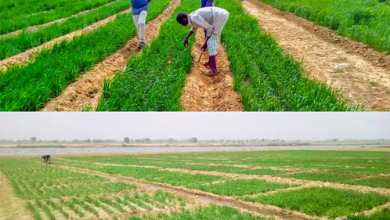
The beetles’ true test came at a tomato farm in Bostan Pishin, where they were released directly onto plants struggling under heavy pest pressure, marking a significant leap of faith for farmers accustomed to chemical sprays.
Results in the Field
The results were striking. Within weeks, farmer estimates showed aphid populations had dropped by approximately 47%, spider mites by 46%, and whiteflies by 16%. As pest pressure eased, tomato yields climbed by as much as 20%.
Bakhtiar Khan, a tomato farmer in Bostan Pishin, described the impact: “I didn’t think insects could do what chemicals do. But the plants recovered, and we didn’t spend money on sprays that season.” For farming communities accustomed to chasing pest outbreaks with ever-larger doses of chemicals, a natural predator had done the job — with no chemical residue left behind, no resistance building in the pest population, and at a fraction of the recurring cost of pesticides.
Why It Matters Beyond One Field
The success of the ladybird beetle trial reflects a broader shift toward biological control and integrated pest management (IPM) approaches, as chemical-resistant pests become more common worldwide and the environmental costs of heavy pesticide use continue to mount. For Balochistan — an arid region already grappling with water scarcity and climate stress — a low-cost, chemical-free pest control method offers a rare win-win: protecting crop yields without further straining fragile soil and water resources.
The initiative also opened space for broader conversations. Researchers used the trial as an opportunity to introduce farming communities to the wider principles of climate-smart agriculture and the ecological value of restoring natural balance to farming systems rather than relying on chemical inputs.
The Road Ahead
The trial faced real challenges, including limited farmer awareness of biological control methods and security constraints that complicated field monitoring in parts of the province. Even so, the results have given researchers a clear roadmap for expansion. Plans are now underway to extend field trials to additional secure areas, strengthen farmer training programs so more growers can confidently adopt the method, and establish local beetle-rearing facilities to ensure a steady, year-round supply of the beneficial insects rather than a one-time release.
Conclusion
For tomato farmer Bakhtiar Khan, the calculation going forward is simple: “If the beetles keep working like this, I don’t need to go back to spraying. That’s better for my field and better for my family.” In the dry, pest-pressured fields of Bostan Pishin, a beetle barely the size of a fingernail is offering Balochistan’s farmers a way to fight crop pests that strengthens the land with every season rather than depleting it — a small but meaningful step toward more resilient, sustainable agriculture in one of Pakistan’s most climate-stressed regions.