
IWMI, LIMCOM Launch AI Digital Twin for Limpopo River Basin
IWMI and LIMCOM launched the Limpopo Digital Twin and WaterCopilot AI tools to help Botswana, Mozambique, South Africa and Zimbabwe manage water security.
IWMI and LIMCOM Roll Out AI-Powered Digital Twin and WaterCopilot for Limpopo River Basin
New digital tools equip water managers from Botswana, Mozambique, South Africa and Zimbabwe with real-time monitoring, forecasting and scenario planning capabilities to navigate transboundary water challenges
The International Water Management Institute (IWMI), in collaboration with the Limpopo Watercourse Commission (LIMCOM), has rolled out artificial intelligence-powered digital tools designed to help LIMCOM Member States manage climate variability and transboundary water challenges across the Limpopo River Basin. The Limpopo Digital Twin and WaterCopilot platforms were launched on April 15 for use by water managers across Botswana, Mozambique, South Africa, and Zimbabwe.
The Challenge of Transboundary Water Management
Managing shared river basins across multiple countries has long presented a distinct set of governance challenges, requiring coordination between national institutions with differing data systems, monitoring capacities, and planning priorities. The Limpopo River Basin, which spans Botswana, Mozambique, South Africa, and Zimbabwe, is no exception, with millions of people across the four countries depending on the basin for agriculture, drinking water, and broader economic activity, even as climate variability increasingly complicates efforts to plan and allocate water resources effectively.
Traditional approaches to transboundary water governance have often been constrained by fragmented or inconsistent data availability, as well as by the technical complexity involved in interpreting hydrological, climatic, and water-use information — a barrier that can limit meaningful participation from water managers who may not have specialized technical training. Addressing these barriers has become an increasing focus for organizations like IWMI and LIMCOM, which have sought to combine digital innovation with participatory governance approaches to make sophisticated water data more accessible and useful to decision-makers across the basin.
Introducing the Limpopo Digital Twin
The Limpopo Digital Twin is an interactive digital replica of the river basin designed to deliver near real-time insights for water planning purposes. Described as the first prototype Digital Twin in Africa, the platform has now reached full maturity and is openly accessible, integrating hydrological, climatic, irrigation, and water-use data into intuitive maps and analytics tools.
By consolidating multiple data streams into a single, visually accessible platform, the Digital Twin is intended to give water managers a clearer, more immediate picture of basin conditions than would typically be possible through traditional, siloed data systems.
WaterCopilot: An AI Conversational Interface
Embedded within the Digital Twin platform is WaterCopilot, an AI agent developed by IWMI in collaboration with Microsoft to serve as a conversational interface to basin data. WaterCopilot allows water managers to query complex hydrological information using plain-language questions in languages such as English or Portuguese, without requiring specialist knowledge of the underlying datasets or platform architecture.
This design is intended to lower the technical barrier to using sophisticated water data, allowing officials at varying levels of technical expertise to directly access and interpret basin information relevant to their decision-making needs.
Capacity-Building Workshop in Maputo
To support the rollout of these platforms, IWMI and LIMCOM hosted a two-day capacity-building workshop focused on testing and scenario development for the Limpopo Digital Twin and WaterCopilot. Held April 15–16 in Maputo, Mozambique, the workshop brought together technical representatives from the four LIMCOM Member States, IWMI representatives, leading experts in digital water management and digital intelligence, and representatives from the International Affairs Office at the United Arab Emirates (UAE) Presidential Court and the American University of Sharjah.
A live demonstration during the workshop showcased WaterCopilot responding to plain-language queries covering reservoir status, environmental flow thresholds, water accounting, and MiniSASS river health scores — a citizen science tool used for monitoring water quality and ecological health. Through the training, stakeholders learned to navigate the Digital Twin’s near real-time operational monitoring capabilities, with WaterCopilot serving as the accessible entry point for users across different technical skill levels.
Co-Designing Scenarios with the Water AI Project
On the workshop’s final day, LIMCOM member states were introduced to the Water AI project, an AI-augmented global hydrological modelling initiative. Water AI is designed to generate simulations of potential future conditions under various scenarios, using AI calibration techniques to align model outputs with real-world observations such as historical rainfall and river flow data. The Limpopo River Basin has been designated as the first real-world test case for this AI-driven hydrological modelling approach.
Ian Overton, IWMI’s Acting Director for Water Data Science, explained that sound hydrological modelling is essential for good water security decision-making, but noted that traditional hydrological models require substantial data and can take months to calibrate, creating a bottleneck in water resource management. He said the Water AI project uses AI tools to accelerate this process, representing a significant step toward faster, better-informed water management decisions.
The Water AI project operates under the CGIAR AI Hub, hosted in Abu Dhabi, and forms part of the UAE’s AI Ecosystem for Global Agricultural Development, an initiative launched with the Gates Foundation and other partners in December 2025. It also serves as the flagship product within the CGIAR Accelerator for Digital Transformation, implemented by IWMI in partnership with the American University of Sharjah and ai71, with support from the International Affairs Office at the UAE Presidential Court.
During the workshop, technical representatives from LIMCOM member states co-developed priority scenarios for the Limpopo River Basin, formally designating it as the primary Water AI project demonstration case for Southern Africa. Rather than simply receiving pre-built tools, participants actively shaped priority scenarios and tested both the Digital Twin and WaterCopilot as shared digital resources for the basin — a participatory approach intended to ensure the technology reflects the realities and needs of the people who will ultimately use it.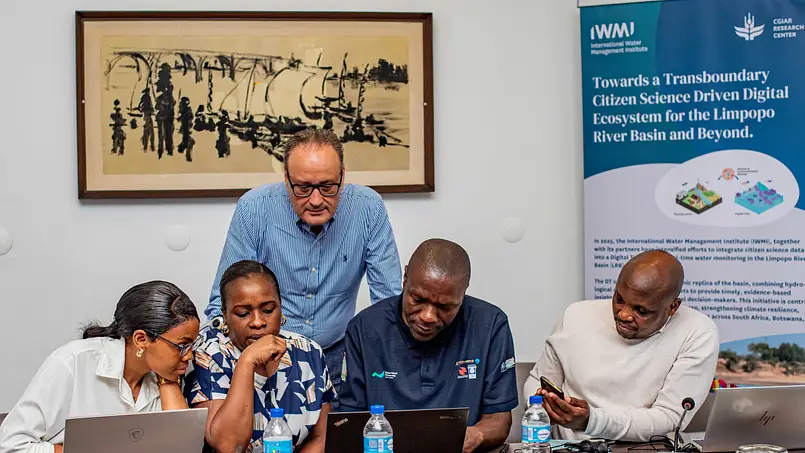
Strengthening Evidence-Based Decision-Making
The workshop was described as a milestone in strengthening evidence-based decision-making within the Limpopo River Basin. LIMCOM and IWMI have expressed continued commitment to ensuring that the millions of people living in the basin — from farmers and communities facing climate variability to governments managing shared water resources across the four countries — benefit from better-informed water management decisions.
LIMCOM Executive Secretary Sergio Sitoe emphasized the importance of stakeholders fully harnessing digital intelligence to drive socio-economic development in this era of digitalization. He noted that the effectiveness of technological innovations such as the Limpopo Management Information System and the Limpopo Digital Twin depends on the active participation of all relevant stakeholders, stressing that maintaining accurate data and ensuring insights remain actionable is a shared responsibility that will allow the basin to improve planning, monitor progress, and drive inclusive growth.
IWMI Country Representative for South Africa, Henry Roman, described the digital tools as a game changer in water resource management, noting that they help ensure decisions are grounded in evidence and science. Roman said the development of these tools reflects the power of partnerships and innovation, and that combining the Digital Twin’s operational capabilities with the scenario-based insights of the Water AI project equips LIMCOM and its member states with the tools needed to navigate the challenges of climate change, land use, and water demand — describing the initiative as a significant step forward for the region and a model for global water governance.