
Women-Run Nawallas Boost Income in Egypt’s Nile Delta
IWMI's Al Murunah project helps women in Egypt's Beheira Governorate run their own artichoke processing facilities, raising daily income by over 50%.
Women-Run “Nawalla” Facilities Transform Artichoke Processing in Egypt’s Nile Delta
Beheira, Egypt — September 9, 2026 — In the Izbat Al-Hamra village of Egypt’s Beheira Governorate, inclusive agricultural production and processing models are shifting income and ownership into women’s hands, as women-run crop processing facilities known as “nawallas” deliver measurable gains in income, equity and climate resilience for farming families in the Nile Delta.
Background
Artichoke covers 60% of farmland in the Izbat Al-Hamra area, roughly 1,188 hectares, with peak harvest running from April through June. The crop structures nearly everything in the community: the calendar, the household budget, and the daily labor of women who have trimmed, sorted and cleaned artichokes for generations. Yet despite providing the labor that sustains this economy, women had no access to financial institutions or markets of any scale, no direct access to buyers or processing facilities of their own, and no say in how the value chain operated. The crop was instead sold through middlemen who set prices and kept most of the value.
This dynamic is what the “nawalla” model — an Egyptian Arabic word meaning “facility” — was designed to change. The initiative was established under the Al Murunah project, led by the International Water Management Institute (IWMI), in partnership with the Center for Environment and Development for the Arab Region and Europe (CEDARE), the International Union for Conservation of Nature (IUCN), and the UK’s Foreign, Commonwealth & Development Office (FCDO).
Reorganizing Ownership, Not the Crop
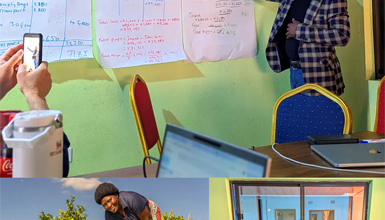
This year, 30 women across three villages processed artichokes through nawallas established for women in the Abu Al-Matamir District. Crucially, the women ran their own facilities — setting schedules, managing operations, and keeping the returns themselves. By the end of the season, daily income for participating women had risen by more than 50%, and for every Egyptian pound the project invested in the units, 8.1 pounds came back.
The model succeeded not by introducing a new crop or product, but by reorganizing who owns the processing units, who manages the income, and who decides what happens next. Three nawalla units are now cooperatively owned, fully operational, and equipped to process a range of crops — including corn, beetroot and peppers in addition to artichokes — depending on the season, providing an ongoing annual income stream for their owners.
Pairing Economic Change with Social Change
The nawallas sit within a broader effort to redefine resilience for families in Beheira. Under Al Murunah+, an IWMI project focused on integrating gender dynamics with nature-based solutions, 150 households completed the Women’s Economic and Social Empowerment (EA$E) curriculum — a structured program of joint sessions for couples on financial planning, shared decision-making and household dynamics. Attendance remained at 98% across all sessions.
Separately, 40 community and government leaders completed a curriculum designed to build an enabling environment for women, with women making up 38.5% of participants themselves. Through these efforts, women’s advisory committees have been established and women’s membership in cooperatives has increased.
As part of Al Murunah+, IWMI also helped place assets directly in the hands of participating families, including agro-processing equipment and climate-smart livestock systems. As a result of this direct ownership, households recorded a 30% increase in income. The programme’s underlying design treats social and economic change as inseparable: stronger economic opportunities for women, paired with improved household decision-making and community support, together help families better absorb and recover from shocks.
Water Security Underpins the Gains
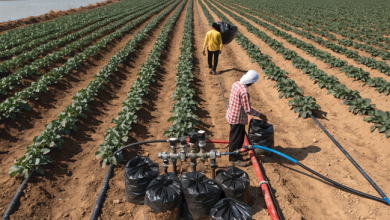
Social change in Beheira has been paired with direct interventions on the land itself. Solar-powered and piped irrigation systems established through the Al Murunah project, and now managed by a newly established Water Users’ Association, serve approximately 8.4 hectares for 14 households — raising irrigation efficiency from 42% to 60% and cutting water losses by roughly 30% per crop. More than 210 hectares have been leveled using laser-guided equipment to create more even fields, reducing water losses by 15–20% and increasing crop productivity by around 10%.
On demonstration farms, soil salinity has been reduced by more than 60% through improved irrigation and drainage combined with natural inputs like gypsum, bringing degraded land back to productive levels. This matters in an area where temperatures have climbed by 0.3 degrees Celsius per decade and drought events have increased by 3% — pressures that translate directly into strain on agricultural livelihoods for farming families, including the women who run the nawallas.
The solar-powered irrigation system alone generates approximately $7,400 in annual economic benefits, equivalent to around $238 per hectare per year, with a return-on-investment payback period of 6.4 years.
Conclusion
Taken together, the figures from Beheira — modest in absolute terms — represent something larger: a reorientation of who the land works for. In a community where women were once excluded from financial institutions entirely and artichoke processing sat at the bottom of the value chain in terms of wages, the nawalla model demonstrates that water security and women’s economic empowerment are not separate agendas, but part of the same story. When the land holds water better, when irrigation reaches the tail end of fields, and when the soil stops working against the farmer, the resilience gains extend directly into household income and decision-making power.