C
Pinglu Canal, 560-Kilometer, and the New Gravity of Southeast Asian Trade
-
Pinglu Canal: vision for a high-grade waterway connecting China’s inland river systems to the southern coast
-
Pinglu Canal Costs The 72-Billion Yuan, Builds Innovative Irrigation System
-
Pinglu Canal Project creates a waterway capable of handling 5,000-ton vessels and navigating a cumulative 65-meter water level drop
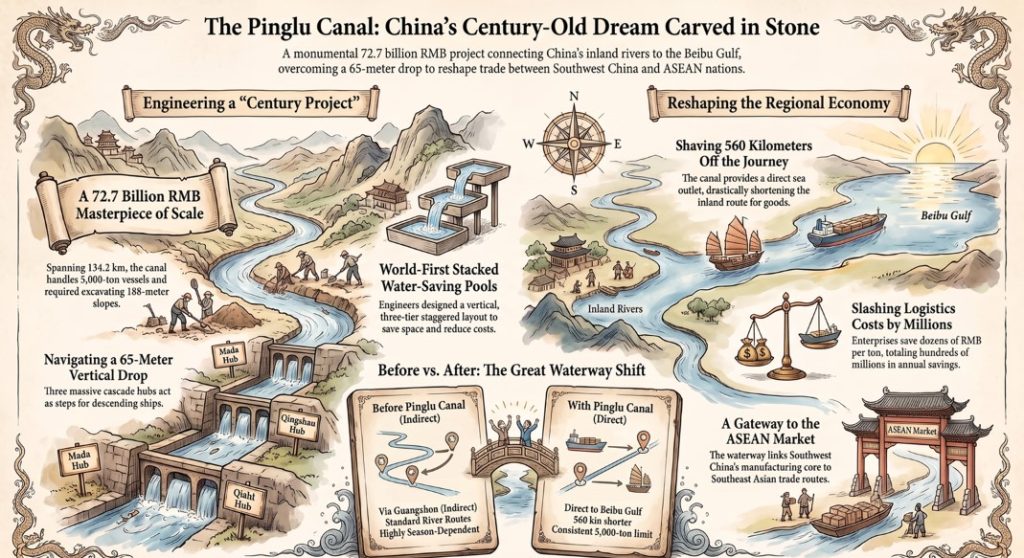
The vision for a high-grade waterway connecting China’s inland river systems to the southern coast is not a modern invention; it was first proposed by Sun Yat-sen in his 1919 treatise, The International Development of China. For over a century, the province of Guangxi lived within a frustrating “river-sea paradox”: despite possessing a coastline on the Beibu Gulf, its primary artery, the Xijiang River, flowed eastward into Guangdong. This forced regional goods to take a 560-kilometer detour to reach the sea.
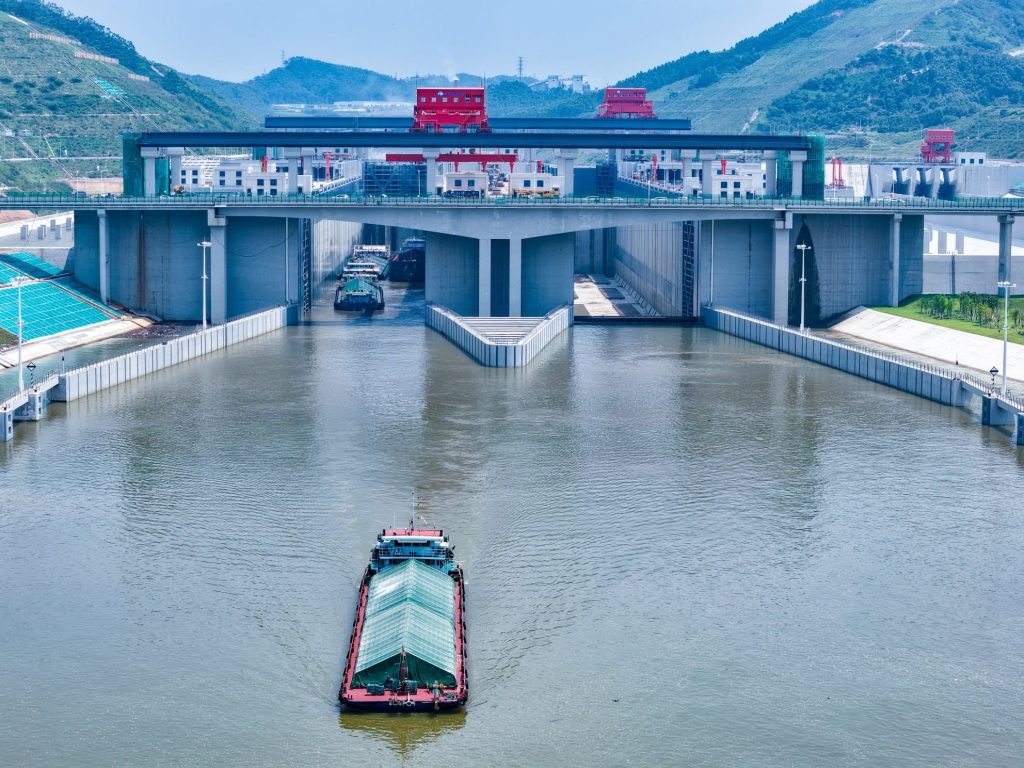
Today, that vision has been realized through a staggering 72.7 billion RMB investment. The Pinglu Canal, a 134.2-kilometer engineering marvel, represents the first major canal project since the founding of the People’s Republic of China. To bridge the gap between the Xijiang and the ocean, engineers had to move mountains—literally—excavating hundreds of millions of cubic meters of earth to create a waterway capable of handling 5,000-ton vessels and navigating a cumulative 65-meter water level drop.
2. The 560-Kilometer Shortcut: Why Logistics Just Changed Forever
The Pinglu Canal is a strategic “hinge” that fundamentally reconfigures the trade relationship between the Greater Bay Area, Southwest China, and the ASEAN markets. By providing a direct southern outlet, the canal slashes transport routes by 560 kilometers.
For strategic analysts, the value lies in a newly optimized supply chain loop: raw materials and minerals from ASEAN flow into Guangxi for processing, move into Southwest China—including landlocked provinces like Yunnan—for manufacturing, and return to ASEAN for consumption. As one worker from Yunnan noted, the project provides his home province with its first true “shortcut to the sea,” finally unlocking a region that has long been hindered by its lack of maritime access.
The economic impact is already visible for enterprises like Nanning Solar in the Eastern New Area. By having a high-capacity waterway “at their doorstep,” companies are saving tens of yuan per ton in logistics costs. For a high-volume enterprise moving 10 million tons of cargo annually, this equates to savings in the hundreds of millions of yuan every year.
3. Engineering Against Nature: The Rock That Turns to Mush
The most significant geological hurdle of the project was the “carbonaceous rock” (碳質岩) found at the Madao Hub. While it appears solid upon first excavation, this black, clay-heavy stone possesses a treacherous property: it softens and loses structural integrity almost instantly when exposed to water or even nighttime mist.
Stabilizing the 188-meter-high slopes—the highest in the entire project—required a grueling, high-stakes construction rhythm. At the Madao Hub alone, where 40 million cubic meters of earth were moved, engineers could not leave the rock exposed for more than a few hours.
“It required a specific technical approach: excavate one level, protect one level. This meant daytime excavation followed by a nighttime rush where teams would spray concrete to seal the rock, preventing rain or night mist from softening the layers. If we hadn’t moved that quickly, the slopes would have easily slid during construction.”
4. A World First: The Three-Tier Stacked Water-Saving Pool
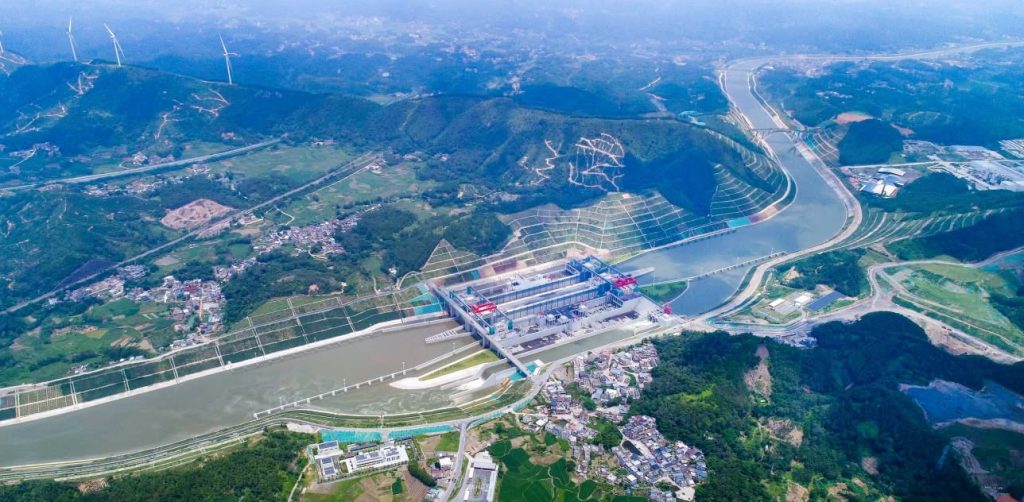
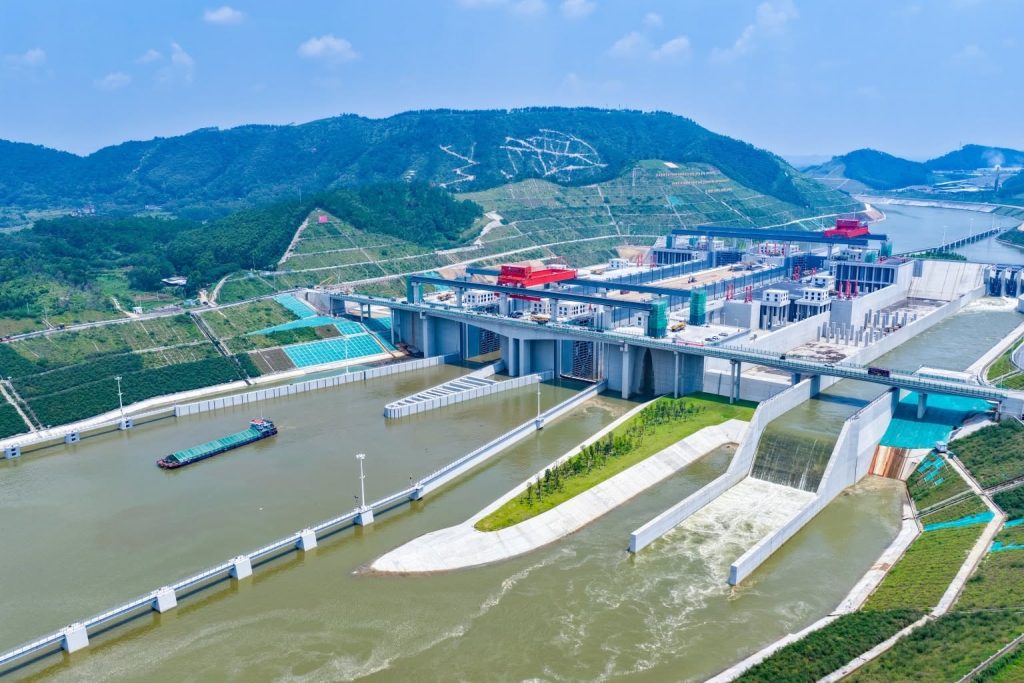
At the Madao Hub, the 65-meter water level drop and the narrow valley terrain made traditional horizontal water-saving pools impossible. The vertical constraints of the 188-meter slopes forced engineers to innovate a world-first “staggered/stacked” layout for their shiplocks.
In this design, the three water-saving pools—each holding between 60,000 and 80,000 cubic meters of water—are stacked vertically rather than laid out side-by-side. This “vertical thinking” provided three massive advantages:
- Land Conservation: Minimized the horizontal footprint in the cramped mountain valley.
- Reduced Excavation: Significantly decreased the volume of rock that needed to be blasted.
- Lowered Construction Costs: Streamlined the materials and labor required for the lock infrastructure.
-

Pinglu Canal project , a innovative model of water management mechanisms, water conservation 3
5. The “Thousand-Year” Legacy: Mangroves and Fishways
The Pinglu Canal is a case study in balancing massive infrastructure with ecological preservation. To protect the sensitive mangrove root systems from silt during underwater dredging, engineers deployed “anti-fouling curtains”—high-molecular-weight orange floating barriers that allow water through while trapping sediment. Furthermore, the Madao Hub features a specialized “vertical slot plus eel passage” fishway, ensuring that local aquatic species can migrate upstream and downstream despite the massive concrete barriers.
Socially, the project has acted as a catalyst for modernization. The relocation of Chili Primary School saw students move from a facility with broken desks and doorless bathrooms to a modern campus. For residents like Mr. Chen, a shop owner who returned home after 20 years in Guangdong, the canal project provided a “one-to-one” housing replacement. His family of 10 moved from a cramped home into a modern, four-story residence, a testament to the project’s local impact.
6. The “Spoon and Brush” Precision at Massive Scale
There is a striking contrast between the heavy machinery used to carve the canal and the manual precision required at its foundation. To ensure “safety for a thousand years,” the base of the shiplocks had to be perfectly clean to create a seamless bond with the concrete.
More than 200 workers were deployed into the foundation pits, using kitchen spoons, brushes, and small shovels to manually clear every pebble and speck of dust. This meticulous human labor is what bridges the gap between a modern megaproject and a historical legacy like the Dujiangyan Irrigation System, which has functioned for over two millennia. As with Dujiangyan, the goal for Pinglu is a structure that remains functional and safe for ten centuries.
7. Conclusion: Beyond the Concrete
The Pinglu Canal is far more than a waterway; it is a fundamental reconfiguration of regional geography. By solving the “river-sea paradox,” China has created a new artery that shifts the gravity of trade toward the Beibu Gulf.
As the first 5,000-ton vessels pass through these innovative stacked locks, the project invites us to consider the long-term. How will this man-made river alter global supply chains over the next hundred years? For the people of Guangxi and the manufacturing hubs of Southwest China, the “Century-Old Dream” is now a 72-billion yuan reality, and the shortcut to the world is finally open.