IWMI, ICAR Sign Four-Year Plan to Scale Climate Solutions
IWMI and ICAR sign a renewed four-year work plan covering AI drought advisories, solar irrigation and One Health initiatives for Indian agriculture.
IWMI and ICAR Sign Four-Year Work Plan to Scale Climate Solutions for Indian Agriculture
New Delhi, India — October 2, 2026 — The International Water Management Institute (IWMI) and the Indian Council of Agricultural Research (ICAR) have signed a renewed four-year work plan to scale climate solutions for Indian agriculture, setting out five areas of joint work spanning AI-driven drought advisories, solar irrigation, and One Health initiatives.
Background
Agriculture employs about 50 percent of India’s workforce, and most of the country’s farmers are smallholders who remain highly vulnerable to climate variability, water scarcity and groundwater overexploitation. IWMI has carried out research on water and agriculture in India for over two decades, maintaining offices in Delhi and Anand, where it is hosted by ICAR under the Department of Agricultural Research and Education (DARE). Through this long-standing presence, IWMI works closely with ICAR, the Indian government, research institutions, and corporate social responsibility initiatives to strengthen the impact of water interventions across the country.
This renewed agreement builds on an earlier IWMI-ICAR collaboration running from January 2024 to December 2025, which focused on assessing synergies and trade-offs in the water-energy-food-ecosystems nexus in India. That earlier phase of cooperation spanned agricultural disaster risk management, improving water productivity, developing strategies for government programs, and advancing global initiatives and South-South cooperation — groundwork that has now been extended and expanded into a new four-year framework.
Five Areas of Joint Work
The renewed plan sets out five areas of collaboration between IWMI and ICAR, centered on scaling practical, science-based climate solutions for Indian farmers. These include AI-driven drought advisories designed to help farmers anticipate and respond to water stress earlier, expanded solar irrigation initiatives to improve water-energy efficiency, and One Health initiatives linking agricultural, environmental and public health outcomes.
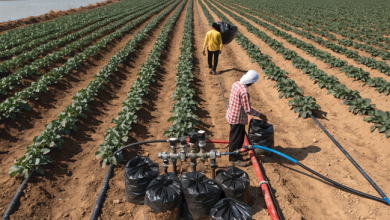
A key area of IWMI’s work in India has long centered on integrating solar-powered irrigation systems to provide reliable water sources in water-scarce regions, boosting agricultural productivity and sustainability while helping to manage India’s heavy reliance on groundwater irrigation. This work is reinforced by complementary initiatives such as the Solar Irrigation for Agricultural Resilience (SoLAR) project, which operates across India, Bangladesh, Nepal and Pakistan, promoting solar irrigation pumps as a way to manage the interlinked water-energy-climate challenges facing South Asian farmers.
Broader Context
IWMI’s engagement in India extends beyond this agreement through initiatives such as the IWMI-Tata Water Policy Research Program, launched in 2000 in partnership with the Tata Trusts, which translates research findings into practical policy recommendations. IWMI also supports broader climate adaptation efforts in India, helping communities withstand extreme weather events while ensuring long-term water security through data-driven approaches such as water accounting.
Conclusion
The signing of this renewed four-year work plan reflects the continuation of a more than two-decade partnership between IWMI and ICAR, now sharpened around five concrete areas of collaboration tailored to India’s current climate and agricultural challenges. As AI-driven drought advisories, solar irrigation and One Health approaches move from research into implementation, the partnership aims to translate accumulated scientific evidence into tangible resilience gains for India’s smallholder farmers, who remain on the front lines of the country’s mounting water and climate pressures.
Categories: