UAE to Rally $6.7 Trillion for UN Water Summit, Says Abdulla Balalaa
UAE water security chief outlines plans to close the global water-financing gap through AI innovation, de-risking mechanisms, and a landmark summit with Senegal.
-
UAE to Rally $6.7 Trillion in Private Investment at December UN Water Summit, Says Abdulla Balalaa
-
UAE water security chief outlines plans to close the global water-financing gap through AI innovation, de-risking mechanisms, and a landmark summit with Senegal.
- By Muhammad Arif
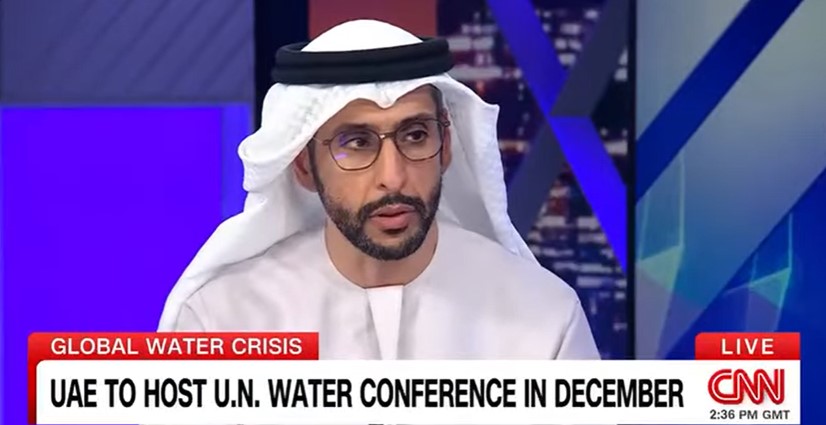
Abu Dhabi — The United Arab Emirates is positioning itself as a global convener in the fight against water scarcity, using a December UN water summit to mobilize private investment, artificial intelligence, and financial de-risking mechanisms aimed at closing a staggering $6.7 trillion global water-financing gap, according to HE Abdulla Balalaa, speaking in an interview with CNN’s Becky Anderson.
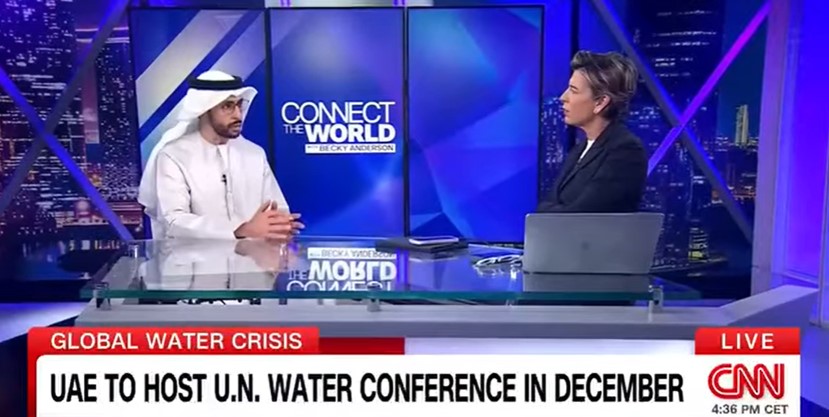
The summit, to be co-hosted by the UAE and Senegal, will bring together governments, multilateral development banks, and private investors to advance six interactive dialogues on water security that were adopted by the United Nations following a broad, inclusive global consultation process. The gathering follows a new partnership with WECF (Women Engage for a Common Future) and will also feature prominently in discussions at the upcoming UN General Assembly (UNGA).
A Financing Gap Too Large for Public Money Alone
At the heart of the UAE’s strategy is a stark financial reality: closing the global water-scarcity gap requires an estimated $6.7 trillion in investment, yet more than 90 percent of current water infrastructure funding comes from public sources. Balalaa framed this imbalance not as a burden but as an opportunity — one that depends on unlocking private capital at scale.
“The scale of investment required simply cannot be met by governments alone,” Balalaa indicated, pointing to de-risking mechanisms and stronger engagement with multilateral development banks as essential tools to make water infrastructure projects attractive to private investors. By reducing the financial risk associated with large-scale water projects — through blended finance structures, guarantees, and technology-driven efficiency gains — the UAE hopes to shift the funding balance and accelerate infrastructure delivery in water-stressed regions worldwide.
Technology, and artificial intelligence in particular, emerged as a central pillar of this strategy. Balalaa described AI-driven tools as key to making water investment both more efficient and more bankable, by improving demand forecasting, reducing losses, and optimizing supply networks in ways that lower operational costs and strengthen the financial case for private participation.
AI and Desalination: Water Security as National Security
Much of the conversation centered on the Gulf region’s own experience managing water scarcity — a challenge the UAE has confronted directly given its heavy reliance on desalination for freshwater supply. Balalaa explained that AI-powered water management systems are now critical to Abu Dhabi’s continued growth, enabling more precise control over water efficiency, supply-demand balancing, and leak detection across desalination-dependent infrastructure.
Notably, Balalaa linked water security directly to national security, arguing that in a region where freshwater is engineered rather than naturally abundant, safeguarding water supply is inseparable from safeguarding national resilience. Abu Dhabi’s long-term growth plans, he noted, are fundamentally dependent on securing future water availability — a dependency that has pushed the emirate to treat water infrastructure investment as a strategic, rather than purely utilitarian, priority.
Despite the scale of regional water scarcity, Balalaa expressed confidence that strong leadership, advanced technology, and robust infrastructure investment have so far prevented shortages in the UAE, positioning the country as a model for how resource-constrained nations can manage water security proactively rather than reactively.
The Mohammed bin Zayed Water Initiative and Global Partnerships
Balalaa pointed to the Mohammed bin Zayed Water Initiative as a flagship example of the UAE’s effort to export its water innovation model globally, leveraging partnerships to tackle water scarcity beyond its own borders. The initiative reflects a broader UAE strategy of combining domestic technological expertise with international diplomatic convening power — using platforms like the December summit to translate national experience into global frameworks for action.
This approach mirrors a wider pattern among Gulf states seeking to position themselves as climate and resource-security leaders on the international stage, using COP-adjacent and UN-affiliated platforms to shape global agendas while showcasing domestically developed solutions.
Setting the Stage for December
With the UN water summit approaching, the UAE’s emphasis on private capital mobilization, AI-driven efficiency, and de-risking mechanisms signals a broader shift in how water security is being framed internationally — not solely as a humanitarian or environmental issue, but as an investable, technology-enabled sector requiring the kind of capital markets engagement more commonly associated with energy or infrastructure financing.
Whether the summit succeeds in meaningfully shifting the 90-percent-public funding imbalance will depend heavily on whether de-risking mechanisms and multilateral bank engagement can convince private investors that water infrastructure offers viable, scalable returns. For the UAE, however, the December summit represents both a diplomatic opportunity and a continuation of a domestic strategy already underway: treating water security as inseparable from technological innovation, economic growth, and national resilience.