
UN General Assembly Adopts Sea-Level Rise Declaration by Consensus
The UN General Assembly adopts an action-oriented declaration on sea-level rise at a September 24, 2026 high-level meeting, aiming to protect vulnerable coastal states.
UN General Assembly Adopts Declaration on Sea-Level Rise as World Leaders Convene in New York
New York, September 24, 2026 — The United Nations General Assembly convened a one-day High-level Plenary Meeting at UN Headquarters to address the existential threats posed by sea-level rise, resulting in a concise, action-oriented declaration adopted by consensus following months of intergovernmental negotiation. The meeting brought together Heads of State and Government, ministers and senior representatives to identify practical priorities and galvanize collective action for the coming decade.
Background
Sea-level rise is no longer a distant or abstract threat — it is already affecting communities and economies in every region, intensifying coastal flooding, erosion, saltwater intrusion, and the loss of ecosystems and biodiversity that protect communities and sustain livelihoods. These pressures are expected to compound as climate-related hazards become more frequent and severe.
This year’s meeting builds directly on the General Assembly’s first high-level meeting on sea-level rise, held on 25 September 2024, at which then-Assembly President Philémon Yang convened a plenary session and panel discussions featuring more than 100 speakers. At that meeting, it was estimated that sea levels would rise by 20 centimetres between 2020 and 2050, with up to 1.2 billion people potentially forcibly displaced by the compounding effects of rising seas. Former Assembly President Dennis Francis described that 2024 meeting as the starting point toward “an ambitious declaration,” stating that such a declaration “is an opportunity to secure prosperity, dignity and rights of all affected countries and communities.”
Reaching Consensus on a Declaration
The General Assembly had earlier decided, through decision 78/558, to hold a one-day high-level plenary meeting no later than the last day of the general debate of its eighty-first session to further consider sea-level rise, with the explicit aim of strengthening international cooperation and collective action — including by supporting developing countries most vulnerable to climate change, as well as coastal communities, in building resilience and adapting to its consequences.
To conduct the intergovernmental negotiations, the President of the General Assembly appointed H.E. Mr. James Martin Larsen, Permanent Representative of Australia to the United Nations, and H.E. Ms. Tania Serafim Yvonne Romualdo, Permanent Representative of Cabo Verde to the United Nations, as co-facilitators. In a joint letter dated 20 August 2026, the co-facilitators confirmed that a silence procedure on the latest draft of the declaration, which concluded on 19 August, was not broken and therefore passed successfully. The co-facilitators described the outcome as “a carefully balanced outcome, which meaningfully progresses the international community’s position on a matter of deep concern for Member States, and which provides a clear framework for implementation and review.”
Meeting Format and Objectives
The High-level Meeting, held from 10 a.m. to 1 p.m. and 3 p.m. to 6 p.m. in Conference Room 4 at UN Headquarters, sought to build common understanding, mobilize political leadership, and promote multisectoral and multi-stakeholder collaboration and international cooperation toward addressing the threats posed by sea-level rise. Participants worked toward developing comprehensive solutions and actionable commitments, with a particular focus on ensuring a resilient and sustainable future for small island developing states and low-lying coastal areas.
According to the concept note issued by the Office of the President of the General Assembly, the meeting sought to shift the international response from fragmented initiatives toward sustained, coordinated and adequately financed action. It aimed to renew high-level political attention to sea-level rise as a cross-cutting challenge with implications for climate action, sustainable development, peace and security, and human rights, while also contributing momentum ahead of the upcoming UN Conferences of the Parties on climate and biodiversity, and injecting further impetus into the UN Decade of Ocean Science for Sustainable Development.
Conclusion
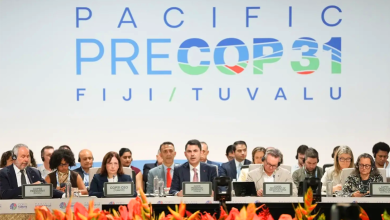
The adoption of this year’s declaration by consensus marks a significant step in the two-year process launched at the 2024 high-level meeting, translating earlier calls for “an ambitious declaration” into a concrete, intergovernmentally negotiated text. With sea-level rise continuing to threaten the survival of low-lying coastal communities and small island states, the declaration’s emphasis on sustained, coordinated and adequately financed action — rather than fragmented initiatives — will now face its real test in the months ahead, as the world turns toward COP31 in Antalya and the 2026 UN Water Conference in Abu Dhabi to determine whether this renewed political attention translates into resources and results on the ground.