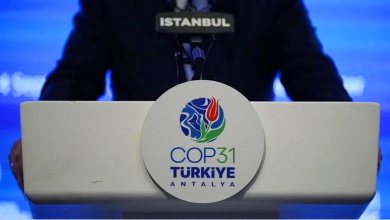
Türkiye’s COP31 Presidency Details Priorities at London Forum
COP31 President-Designate Murat Kurum outlined the "35 by 35" electrification target, methane reduction, and city resilience priorities in London.
Türkiye’s COP31 Presidency Outlines Priorities at London Climate Innovation Forum
Minister Murat Kurum details “35 by 35” electrification target, methane reduction, resilient cities and finance priorities ahead of November’s Antalya summit
Türkiye’s COP31 President-Designate Murat Kurum laid out the incoming Presidency’s key priorities for the upcoming climate summit during an address at the Climate Innovation Forum in London, hosted in partnership with E3G and the UK government, as part of a broader push to build momentum ahead of COP31 in Antalya this November.
A COP Focused on Implementation
Kurum’s address arrived at what he described as a difficult moment for global cooperation, citing lingering economic costs from recent conflicts, deepening debt pressures across many countries, and the arrival of a severe El Niño weather pattern. He referenced research suggesting that El Niño events can carry costs of around five trillion dollars, with this year potentially becoming the most expensive on record — costs that come before accounting for loss of life.
Against this backdrop, Kurum framed COP31 as an opportunity to reverse this trajectory, emphasizing that the Antalya summit needs to send a clear signal of collective commitment and produce results that tangibly improve people’s lives. He described the London forum as a critical step in a broader process that began with the formal launch of several initiatives in Germany two weeks earlier, and which organizers hope will culminate in expanded participation from businesses, institutions, NGOs, and charities by the end of the London gathering.
Electrification as a Flagship Priority
Central to Kurum’s remarks was electrification, which he described as a theme now under active discussion in both government cabinets and corporate boardrooms, driven by the need to protect countries, businesses, and households from volatile energy prices. He connected the issue directly to everyday consumer decisions, from vehicle purchases to home heating choices.
Kurum confirmed that the COP31 Presidency intends to use the summit to advance a global conversation around a target of meeting 35% of final energy consumption through electricity by 2035 — commonly referred to as the “35 by 35” target. He said this goal would be pursued through electrification of transportation, buildings, and industry, supported by investment in modern grid infrastructure, and noted that it already carries backing from organizations including the International Energy Agency, the International Renewable Energy Agency, and the Global Renewables Alliance.
Citing a recent survey by the We Mean Business Coalition, Kurum noted that the business community appears well-prepared for this shift, with 90% of surveyed companies expecting to electrify their operations by 2035.
He also pointed to two conditions he described as essential to the target’s success: ensuring that rising electricity demand is met with clean energy supply, consistent with the first Global Stocktake agreed at COP28 in Dubai, and strengthening financial and technological support for developing countries. On this latter point, Kurum referenced the Baku Finance Goal, under which countries agreed in 2024 to mobilize at least $300 billion annually by 2035, while noting that overseas development assistance saw its largest annual decline on record last year. He committed the incoming Presidency to keeping development finance on the agenda and calling on donor countries to meet their contributions.
Beyond Electrification: Waste, Cities, and Efficiency
While describing electrification as a flagship COP31 initiative, Kurum outlined several additional priority areas. He referenced Turkish First Lady Emine Erdoğan’s Zero Waste Movement and an associated methane reduction initiative, noting that the waste sector accounts for approximately 20% of human-caused methane emissions and that proven, scalable solutions already exist. He said the Presidency has set a global target of halving the increase in waste production by 2035.
On resilient cities, Kurum pointed to Türkiye’s experience rebuilding following the 2023 earthquakes, describing reconstruction efforts across 11 provinces and more than 200 construction sites that delivered 455,000 homes to affected residents. He said these homes were built to high energy efficiency standards, reducing energy consumption by around 40% while meeting earthquake-resilience requirements. Building on this experience, he said COP31 will put forward a target of reducing energy consumption intensity in the building sector by at least 25% by 2035.
Kurum additionally raised green industrialization as a priority area connected to electrification, along with a target of increasing the use of recycled materials in manufacturing to at least 15% by 2035. He also referenced the previously announced Climate Implementation Bridge initiative, intended to strengthen alignment between climate goals and economic development policy, particularly for developing and least developed countries.
Climate Literacy and Education
Kurum emphasized the importance of public awareness and climate literacy in sustaining societal support for climate action, arguing that stronger public engagement makes it harder for governments to remain indifferent to these issues. He said the Presidency aims to see climate change incorporated into educational curricula across more countries by 2030, with a particular emphasis on early childhood education.
Business Engagement and Bilateral Cooperation
Kurum announced that, in partnership with the Union of Chambers and Commodity Exchanges of Türkiye (TOBB), the Presidency is launching the COP31 Business Forum, described as a year-long platform intended to mobilize business participation ahead of a Business Summit scheduled for November 12–13 in Antalya.
He closed his remarks by underscoring the cooperative structure of the COP31 Presidency, describing Türkiye and Australia as working in close coordination throughout the process, alongside COP31 President of Negotiations Chris Bowen of Australia. He noted continuity with decisions made at previous COP summits in Brazil, Azerbaijan, and Dubai, which the incoming Presidency intends to help carry forward into implementation at Antalya.