
Green Tourism Pakistan Hosts Buddhist Monks to Discuss Gandhara Heritage
Green Tourism Pakistan welcomed Buddhist monks from Thailand and Laos to Islamabad to discuss preserving Pakistan's Gandhara heritage sites.
Green Tourism Pakistan Hosts Buddhist Monks from Thailand and Laos to Discuss Preservation of Gandhara Heritage
Delegation visit to Islamabad head office highlighted Pakistan’s Buddhist archaeological legacy and efforts to welcome international followers exploring their historical roots
Green Tourism Pakistan welcomed a delegation of Buddhist monks from Thailand and Laos to its head office in Islamabad, including a visit to the organization’s Media Studio, where a recorded conversation explored Pakistan’s Buddhist heritage and the legacy of the ancient Gandhara civilization.
Pakistan’s Gandhara Heritage and Its Global Significance
The Gandhara civilization, which flourished across what is now northern Pakistan and eastern Afghanistan between roughly the 1st and 7th centuries CE, holds a place of major significance in the history of Buddhism. The region is widely recognized among historians and archaeologists as a critical center for the development of Buddhist art, philosophy, and monastic practice, producing some of the earliest known figurative depictions of the Buddha and serving as a key transit point along ancient trade and pilgrimage routes connecting South Asia with Central Asia and beyond.
Sites associated with Gandhara — including stupas, monasteries, and archaeological remains scattered across present-day Khyber Pakhtunkhwa and Punjab — continue to draw interest from Buddhist communities and heritage scholars around the world, particularly from countries such as Thailand, Laos, Sri Lanka, and Myanmar, where Buddhism remains a dominant religious and cultural tradition. For many Buddhist practitioners internationally, these sites represent not just archaeological curiosities but meaningful points of spiritual and historical connection to the origins of their faith.
In recent years, Pakistan has placed growing emphasis on positioning its Buddhist heritage sites as a distinct pillar of its broader tourism strategy, seeking to attract international visitors — particularly from Buddhist-majority countries — while also working to preserve archaeological sites that face ongoing conservation challenges.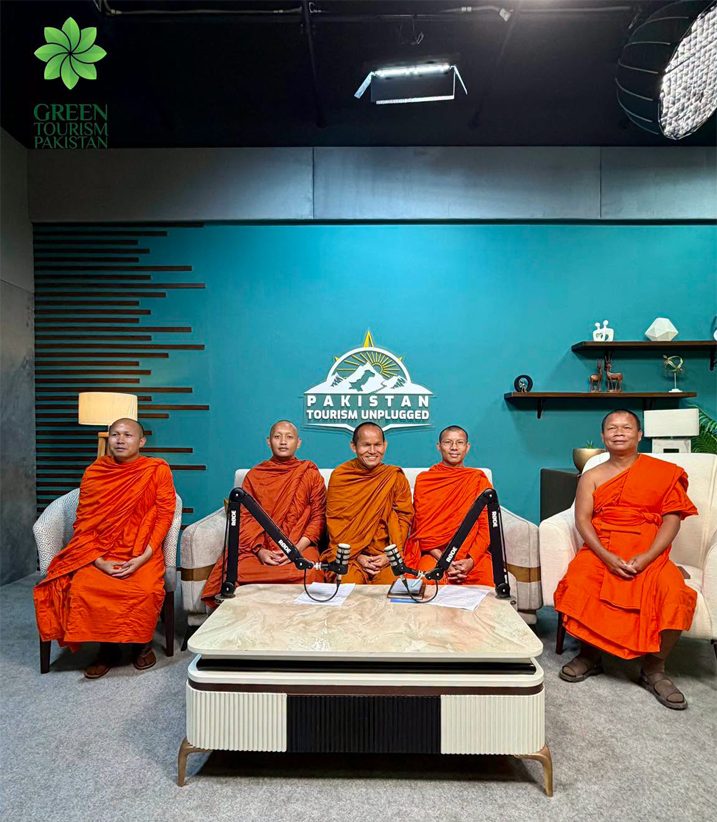
The Delegation Visit
The visiting delegation of Buddhist monks from Thailand and Laos was received at Green Tourism Pakistan’s head office in Islamabad, where they were welcomed by the organization’s Secretary, its Director of Policy, and its Director of Media. Also present was Mr. Imran Shaukat, who serves as Green Tourism Pakistan’s Ambassador for the Promotion of Buddhist Heritage, and who presented commemorative souvenirs to the visiting monks as part of the reception.
As part of the visit, the delegation toured Green Tourism Pakistan’s Media Studio, where a recorded conversation was held focusing on Pakistan’s Buddhist heritage, the legacy of the Gandhara civilization, and the importance of preserving these historic sites. The discussion also touched on the broader goal of welcoming followers of Buddhism to explore the historical roots of their tradition within Pakistan.
Green Tourism Pakistan’s Broader Heritage Mission
Green Tourism Pakistan has framed the visit as part of its ongoing commitment to promoting, preserving, and sharing Pakistan’s cultural and historical heritage with an international audience. The organization’s engagement with Buddhist heritage specifically — including the appointment of a dedicated Ambassador for the Promotion of Buddhist Heritage — reflects a targeted effort to build stronger ties with Buddhist communities abroad and position Pakistan’s archaeological sites as accessible, meaningful destinations for pilgrimage and cultural tourism.
Such engagements are often intended to serve a dual purpose: strengthening diplomatic and cultural ties with countries where Buddhism holds religious significance, while also raising international awareness of the conservation needs facing Pakistan’s historic Buddhist sites, many of which require sustained investment and international collaboration to preserve for future generations.