


Dasu Hydropower Project: First RCC Dam Cushion Concrete Pour and Tailrace Tunnel Breakthrough
Dasu Hydropower Project finished its first cushion concrete pour for the RCC dam and holed through the No.1 tailrace tunnel on 20–21 November 2026.
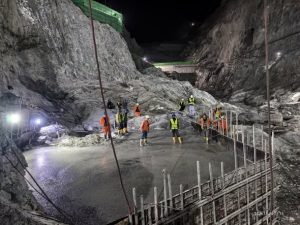
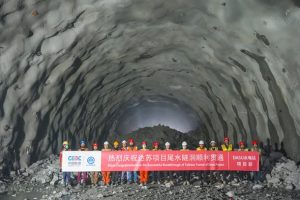
Pakistan local time, 20–21 November 2026: The Dasu Hydropower Project has reached two construction milestones, according to a post from the project team. The first cushion concrete pour for the roller-compacted-concrete (RCC) dam has been completed, and the No.1 tailrace tunnel has been holed through.
The two milestones
First cushion concrete pour. The pour marks the dam’s shift from foundation excavation to concrete placement. The project team says it validates its site management, concrete supply and safety control capabilities. Cushion concrete is typically a layer placed on prepared rock to create a clean, level base before the main body of the dam is built.
Tunnel breakthrough. The No.1 tailrace tunnel has been holed through. The team describes it as the critical water outlet passage for the powerhouse units, and says the breakthrough paves the way for follow-up lining works. A tailrace tunnel carries water away from the turbines back to the river after it has generated electricity.
The team said the two achievements follow a “Q4 sprint for targets” initiative, in which it has intensified construction coordination to deliver steady progress. The post does not give tunnel dimensions, concrete volumes or a schedule for the next stages.
Background: the project
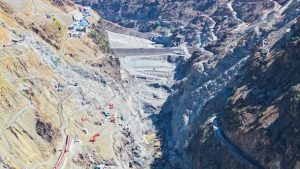
Dasu is a 4,320 MW project on the Indus River in Upper Kohistan district of Khyber Pakhtunkhwa, funded with World Bank support. It is being developed in stages, with Stage I accounting for 2,160 MW. The post describes it as a flagship project of the China–Pakistan Economic Corridor (CPEC).
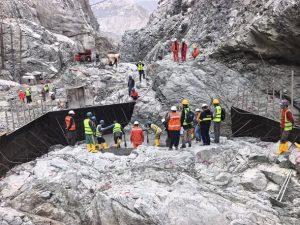
A full-scale RCC trial began earlier this year to validate construction methods, assess logistics and operational systems, confirm quality standards and train the workforce, with technical teams from the contractor, consultants and WAPDA reviewing the results before approving RCC works at the main dam. At that time, main dam RCC placement was scheduled to begin later this year, subject to availability of pozzolan material from the Gini area, and work was under way across 23 work fronts, including the main dam foundation, underground powerhouse and underground transformer cavern.
The path to this point has had steps. In February, WAPDA said crushing and batching plants required for RCC production were complete and operating, and that pouring of RCC for the main dam would start during the year. In late September, WAPDA announced that extraction and transport of pozzolan from Gini had begun, and its chairman asked the contractor to deploy more resources at Dasu. On 28 October, the federal water resources minister and WAPDA chairman visited the project and inaugurated the Barseen Bridge on the relocated Karakoram Highway.
Why the tailrace tunnel matters
Tailrace tunnels are part of the underground powerhouse system. A technical paper on Dasu’s design describes an underground powerhouse, with the power system on the left bank and long tailrace tunnels, and lists the tunnels as concrete-lined with a size of 10 by 12.5 metres, each designed for a discharge of 650 cubic metres per second. That paper dates from an earlier design stage, so final specifications may differ. The breakthrough gives crews continuous access through the tunnel, which allows lining to begin from end to end.
Why the first pour matters
Foundation excavation is the preparation phase, and concrete placement is the construction phase. The same paper lists the main dam as an RCC gravity structure with an RCC volume of about 4.25 million cubic metres. At that scale, the first pour starts a long production cycle in which concrete supply, quality control and safety have to work continuously, which is why the team stresses that the pour tested those systems.
Why Dasu matters for Pakistan
The project team says that on completion Dasu will ease Pakistan’s power shortages, optimise the energy mix and boost local jobs and livelihoods. As a run-of-the-river project, it would add large-scale hydropower without the big reservoir of a storage dam, though it has less ability to hold water for dry periods than Diamer Basha, which is being built further upstream.
What the post does not say
The announcement does not give the date for first power from Dasu. Earlier WAPDA statements in 2025 expected generation to start in 2027, but schedules have shifted since, and the post offers no update. Readers should check WAPDA’s own announcements for the current timetable.
What to watch
Three developments would show progress. First, the pace of RCC placement after the cushion layer, since the main dam is the longest activity. Second, the start of lining works in the No.1 tailrace tunnel and breakthroughs in the remaining tunnels. Third, any revised commissioning date from WAPDA. The project team says it will keep prioritising safety and quality.
Conclusion
The cushion concrete pour and the tailrace tunnel breakthrough move Dasu from preparation to core construction on both the dam and the powerhouse side. For a project central to Pakistan’s hydropower plans and to CPEC, the next test is sustaining concrete production and finishing tunnel lining. The project team calls it a landmark symbol of China–Pakistan friendship, but its value to Pakistan will be measured in megawatts delivered.