

Swat Climate Emergency Floods: Alarming GLOF Warning Reopens Decade of Devastating Trauma
The Swat climate emergency floods crisis deepens as a new GLOF alert triggers memories of repeated disasters since 2010 — exposing how urban expansion into floodplains and accelerating glacier melt threaten Upper Swat's communities and culture.
The Swat climate emergency floods crisis has resurfaced with renewed urgency, as authorities issued a Glacial Lake Outburst Flood (GLOF) alert on June 27 for the northern districts of Khyber Pakhtunkhwa, including Swat — warning that soaring temperatures are accelerating snow and glacier melt across mountain valleys, raising the risk of flash flooding, landslides and sudden inundation downstream.
For the people of Swat, this warning is not theoretical. It is a return to a decade-long emergency that has already reshaped roads, bridges, livelihoods, identities and the very relationship between communities and the river that sustains and threatens them in equal measure.
1. The June 2026 GLOF Alert: What Was Issued and Why
The Swat climate emergency floods warning issued on June 27, 2026, covers the northern districts of Khyber Pakhtunkhwa, with Swat among the most directly named and most vulnerable areas.
The alert specifically warns that soaring temperatures are expected to accelerate snow and glacier melt across mountain valleys — creating elevated risk of:
- Flash flooding in valley settlements
- Landslides on unstable mountain terrain
- Sudden inundation of downstream communities
Authorities have urged:
- Monitoring of vulnerable sites — particularly glacial lakes assessed as hazardous
- Evacuation preparedness in at-risk communities
- Public awareness campaigns for residents living along rivers and streams
This is the operational response to a danger that Swat’s residents understand not as a forecast, but as a continuation of lived experience.
Track current GLOF risk areas in Pakistan at the NDMA Pakistan official alerts page
2. Swat Climate Emergency Floods: A Crisis More Than a Decade in the Making
For the residents of Swat, the June 2026 GLOF warning did not arrive as new information. It reopened memories of a crisis that has unfolded over more than a decade — one measured not only in damaged roads and collapsed bridges, but in disrupted identities, broken landscapes and communities learning to live with uncertainty.
This is the essential context for understanding the Swat climate emergency floods: it is not a single disaster event, nor even a series of unconnected incidents. It is a sustained, ongoing condition — a decade-plus pattern of recurring environmental shock that has fundamentally altered how an entire region experiences time, place and security.
Long before flood damage became international news, communities in Upper Swat had already begun documenting change. From Gabral to Mankiyal, from Matiltan to Daral, repeated floods and climate-linked extremes since around 2010 have reshaped everyday life across the valley.
Pakistan Flood Alert Glacial Lake Outburst: NDMA’s Critical Warning
3. The Swat River: A Dynamic System Under Mounting Pressure
To understand the Swat climate emergency floods crisis, it is necessary to understand the river at its centre.
The Swat River has always been dynamic — its channels shift, widen and reclaim floodplains during periods of high discharge. This is not a malfunction of the river system; it is its natural behaviour, honed over geological time as rivers find equilibrium with the landscapes they flow through.
What has changed is not the river’s fundamental nature, but the relationship between the river and the human settlements around it. Changing climate patterns, combined with expanding development, have altered this relationship in ways that increase risk and reduce resilience.
When a river that has always reclaimed its floodplain during high-discharge events encounters new construction built directly within that floodplain, the result is not the river behaving abnormally. It is human development placing itself in the path of a natural process that was always going to occur.
4. Satellite Evidence: How Bahrain’s Urban Expansion Increased Flood Exposure
One of the most compelling and data-driven dimensions of the Swat climate emergency floods story comes from satellite-based monitoring conducted through Space4Climate, powered by the Pakistan Space and Upper Atmosphere Research Commission (SUPARCO).
This satellite evidence has highlighted how urban expansion into active floodplains at Bahrain — one of Swat’s most significant tourist and commercial centres — increased exposure to flood damage.
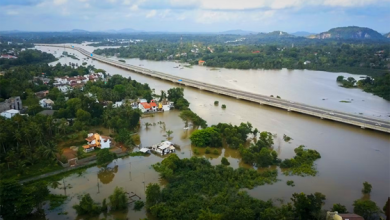
Comparative satellite imagery published for the period 2010–2022 shows substantial construction along sections of the river corridor, progressively narrowing the river’s natural water pathways in the years before the destructive floods of August 2022.
This is not circumstantial evidence. It is documented, time-stamped, satellite-verified proof that the human-built environment in Bahrain expanded into space the river had historically used during high-flow events — setting the stage for catastrophic damage when those high-flow events inevitably occurred.
SUPARCO’s continuous satellite-based monitoring of river behaviour and surrounding land use is now positioned to support informed decision-making for flood risk reduction and climate-resilient development — a capability that, if applied proactively rather than retrospectively, could meaningfully reduce future damage from the Swat climate emergency floods pattern.
5. 89 Flood Events in 25 Years: The National Pattern Behind Swat’s Crisis
The Swat climate emergency floods pattern is not unique to one valley. It reflects a national trend documented by the Emergency Events Database (EM-DAT): Pakistan has faced 89 flood events in the last 25 years.
This figure — nearly 3.5 flood events per year on average across the country — demonstrates that flooding is not an occasional disruption to Pakistan’s normal condition. It is, increasingly, a defining and recurring feature of the national climate reality.
Critically, the data shows that the impacts of these floods have become more severe due to a combination of factors:
- Increasing urban expansion into vulnerable areas
- Development within active riverbeds and floodplains — exactly the pattern documented at Bahrain
- Climate change intensifying the underlying hydrological extremes that trigger floods in the first place
The Swat case is, in this sense, a microcosm of a much larger national failure: the systematic placement of human development in spaces that natural river systems require during periods of extreme flow — a pattern repeated across multiple river valleys throughout Pakistan.
6. Beyond Infrastructure: The Hidden Human Cost of Repeated Disasters
Physical destruction tells only part of the Swat climate emergency floods story. Teachers, local organisers and cultural workers in the region increasingly speak about consequences that infrastructure damage statistics cannot capture:
6.1 Anxiety During Monsoon Seasons
For communities that have experienced repeated flooding since 2010, the approach of each monsoon season now carries a documented psychological burden — anticipatory anxiety rooted in lived experience of previous disasters.
6.2 Prolonged Uncertainty Among Displaced Families
Families displaced by flooding often face extended periods without resolution — neither fully recovered to their previous circumstances nor settled into a stable new normal.
6.3 Changing Settlement Patterns
Repeated flood damage is altering where and how communities choose to live, working against generations of established settlement patterns shaped by access to water, agricultural land and trade routes.
6.4 Weakening Community Traditions Rooted in Place
Perhaps most significantly, the Swat climate emergency floods crisis is gradually weakening community traditions and cultural practices that are intrinsically tied to specific landscapes — traditions that cannot simply be relocated when communities are displaced.
For many younger residents, repeated disaster cycles have fundamentally altered how they imagine their future in the valley — a generational shift in relationship to place that may prove as consequential as the physical damage itself.
7. Zubair Torwali’s Warning: “Mountains Are Not Empty Landscapes”
Among the most consistent and articulate voices addressing the full dimensions of the Swat climate emergency floods crisis is Zubair Torwali, a cultural and linguistic activist and researcher from Upper Swat.
Torwali has repeatedly argued in public discussions and writings that development and climate responses in mountain regions should not be reduced to engineering solutions alone.
His central insight — that “mountains are not empty landscapes” — challenges a persistent tendency in disaster management to treat mountain valleys as primarily physical-infrastructure problems requiring physical-infrastructure solutions.
Torwali emphasises that when communities are displaced or landscapes transformed by climate disasters, languages, memories and cultural practices are also placed at risk. Swat is home to linguistic communities — including speakers of Torwali and other regional languages — whose cultural transmission depends on stable community continuity in specific places.
When repeated flooding forces displacement, disrupts seasonal patterns and erodes community cohesion, it threatens not only homes and infrastructure but the intangible cultural heritage embedded in oral traditions, place names, seasonal practices and intergenerational knowledge transfer.
8. August 2022: The Floods That Forced a National Reckoning
The August 2022 floods marked a moment of national reckoning for Pakistan — and for the Swat climate emergency floods crisis specifically.
Across northern Pakistan, extreme rainfall combined with already-swollen rivers to overwhelm settlements and infrastructure on a catastrophic scale. In Bahrain and the surrounding areas of Swat, the destruction reignited debate over land use, river governance and construction practices within active flood corridors.
The satellite assessments referenced earlier drew direct attention to the overlap between damaged structures and historically active river areas — providing scientific confirmation of what local communities had already understood through lived experience: that the buildings destroyed in 2022 had, in many cases, been constructed in spaces the river had always required during high-flow events.
This was not, the evidence suggests, primarily a story of unprecedented natural disaster. It was, at least in significant part, a story of development decisions that placed human infrastructure in conflict with established river behaviour — a conflict the river was always going to win.
9. What Adaptation Actually Requires: Beyond Engineering Solutions
Climate scientists increasingly warn that warmer conditions are amplifying hydrological extremes across Swat and similar mountain regions: accelerated glacier melt, more intense rainfall, and increasingly unstable mountain systems.
The current GLOF warning places Swat at what observers describe as a crossroads. Authorities have advised communities to avoid riverbanks, maintain evacuation readiness, and strengthen local monitoring systems. But genuine adaptation to the Swat climate emergency floods pattern requires choices that extend well beyond emergency response protocols.
Scientists argue for:
- Stricter floodplain regulation — preventing the kind of construction documented at Bahrain from recurring
- Better mountain planning — integrating climate risk assessment into all development decisions
- Protection of natural river corridors — preserving the space rivers require during high-flow events
- Investment in community-based resilience — building local capacity for monitoring, early warning and response
But local voices, led by figures like Zubair Torwali, add a requirement that engineering-focused approaches often miss entirely: climate adaptation must also protect people’s relationship with place.
A flood-resilient Swat that has lost its languages, its oral traditions and its communities’ sense of belonging would represent adaptation that has failed at its deepest level — preserving infrastructure while losing the culture that gave the valley its meaning.
Pakistan Climate Budget Cut: Sherry Rehman’s Warning on Monsoon Preparedness
10. Conclusion: Swat Climate Emergency Floods at an Unavoidable Crossroads
The Swat climate emergency floods crisis, reignited by the June 2026 GLOF alert, is no longer a question of whether the mountains of Swat are changing. The satellite evidence, the EM-DAT flood data, the lived testimony of communities since 2010, and the catastrophic confirmation of August 2022 have settled that question definitively.
The question that remains — the one that will determine Swat’s trajectory over the coming decade — is whether policy, planning and public memory can change quickly enough to live with what comes next.
This requires confronting uncomfortable truths: that urban expansion into active floodplains at places like Bahrain materially increased flood exposure; that Pakistan’s 89 flood events over 25 years reflect a worsening national pattern, not a series of unfortunate coincidences; and that climate adaptation focused solely on engineering solutions will fail the cultural and human dimensions of communities like those in Upper Swat.
Zubair Torwali’s insistence that mountains are not empty landscapes is, ultimately, the central lesson of the Swat climate emergency floods crisis. The valley’s rivers, its glaciers, its languages and its communities are bound together in a relationship that climate change is actively unraveling.
Whether that unraveling can be slowed — through better floodplain governance, satellite-informed planning, community-based resilience and genuine respect for the cultural stakes involved — will determine not just how many bridges survive the next flood, but whether Swat remains, in any meaningful sense, the place its people have always called home.