
World Has Entered an Era of “Global Water Bankruptcy”: UN Report
A new UNU-INWEH report declares the world has entered "Global Water Bankruptcy" — a post-crisis state where over 2 billion people lack safe drinking water and damage to aquifers, glaciers, and wetlands may be irreversible.
-
World Has Entered an Era of “Global Water Bankruptcy”: UN Report
-
A new UNU-INWEH report declares the world has entered “Global Water Bankruptcy” — a post-crisis state where over 2 billion people lack safe drinking water and damage to aquifers, glaciers, and wetlands may be irreversible.
New UNU-INWEH study says humanity is drawing down water “savings” — aquifers, glaciers, and wetlands — faster than nature can replenish them, with damage in many regions now irreversible
A sweeping new report from the United Nations University Institute for Water, Environment and Health (UNU-INWEH) has issued one of the starkest warnings yet on the state of the world’s water systems, declaring that the planet has entered an era of “Global Water Bankruptcy.”

Released in 2026 to mark UNU-INWEH’s 30th anniversary, the 72-page report — authored by water scientist Kaveh Madani with contributions from more than a dozen international researchers — argues that the familiar language of “water stress” and “water crisis” no longer captures what is actually happening across the globe. Instead, many human-water systems have moved into a post-crisis state of failure, where past levels of water supply and ecosystem function can no longer realistically be restored.
What Is “Water Bankruptcy”?
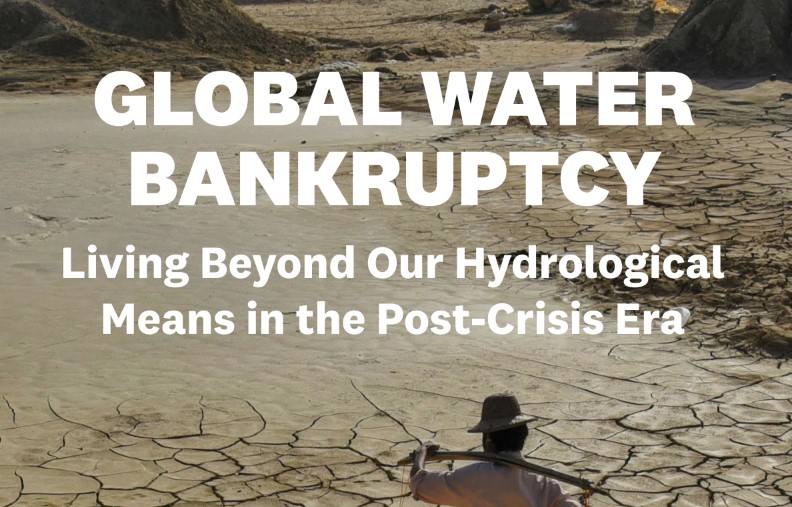
The report defines water bankruptcy as a condition in which long-term water use has exceeded both renewable inflows and safe depletion limits for so long that the resulting damage becomes irreversible, or effectively irreversible, on human timescales.
The authors use a financial analogy: societies have been living not just off their water “income” — annual renewable rainfall and river flow — but off their water “savings,” drawing down aquifers, glaciers, soils, and wetlands that took centuries or millennia to accumulate.
“Compacted aquifers do not rebound, subsided deltas do not rise, extinct species do not return, and lost lakes cannot be restored within planning horizons.”
This distinguishes bankruptcy from water stress, where high pressure still allows recovery, and water crisis, where an acute, time-bound shock can in principle be overcome. Water bankruptcy, the report argues, is different — and requires an entirely different governance response: not crisis management aimed at “getting back to normal,” but bankruptcy management focused on preventing further collapse and building a new, sustainable baseline.
The Numbers Behind the Warning
The report backs its central claim with figures drawn from global data on water access, groundwater, glaciers, and drought:
- Nearly 75% of the world’s population lives in countries classified as water-insecure or critically water-insecure.
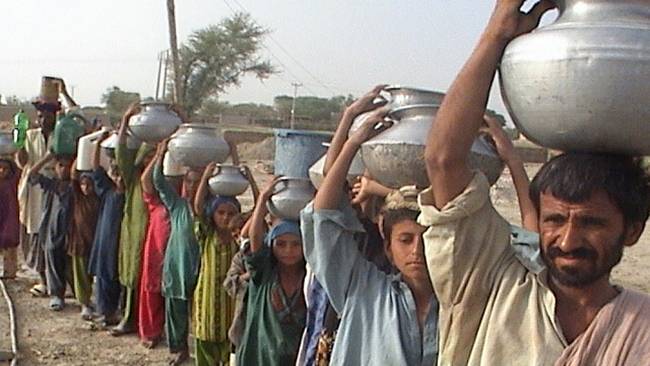
- 2.2 billion people still lack safely managed drinking water.
- 3.5 billion people lack safely managed sanitation.
- Almost 4 billion people experience severe water scarcity for at least one month per year.
- 1.8 billion people — nearly one in four — were living under drought conditions in 2022–2023.
Groundwater and Aquifers in Crisis
Groundwater now supplies about 50% of global domestic water use and over 40% of irrigation water, yet the report finds this critical buffer is being pumped down faster than it can recharge:
- 70% of the world’s major aquifers show long-term declining trends.
- Excessive groundwater extraction is driving land subsidence across more than 6 million square kilometers — nearly 5% of global land area — in densely populated zones home to close to 2 billion people.
- In Türkiye’s Konya Plain, unsustainable groundwater pumping for water-intensive crops has caused the ground itself to collapse, producing nearly 700 sinkholes by late 2025.
Vanishing Glaciers and Wetlands
The report also highlights the loss of natural water storage in mountain and wetland ecosystems:
- The world has already lost more than 30% of its glacier mass in multiple locations since record-keeping began, threatening water supplies for an estimated 1.5–2 billion people who depend on mountain “water towers.”
- Wetlands provide ecosystem services valued at over US$5.1 trillion — roughly equal to the combined annual GDP of the world’s 135 poorest countries — yet are vanishing at an accelerating rate.
Agriculture and Drought Costs
Agriculture remains the largest single pressure point:
- 70% of global freshwater withdrawals go to agriculture.
- 3 billion people and more than half of global food production are concentrated in water-stressed or water-scarce regions.
- Drought-related losses to agriculture, energy, and other sectors already cost the world US$307 billion per year — more than the annual GDP of many nations.
A Call for a New Kind of Water Governance
Rather than simply cataloguing damage, the report calls for a fundamental shift in how the world approaches water policy. Its key policy messages include:
- Recognize water bankruptcy as a distinct state — separate from stress or crisis — requiring institutions built for insolvency and irreversibility, not just short-term recovery.
- Treat anthropogenic drought as the new normal. Much of today’s water shortage is driven by over-allocation, groundwater depletion, land degradation, and pollution — not natural variability alone.
- Address both quantity and quality. Even where water volumes appear stable, pollution and salinization are shrinking the truly usable share.
- Combine mitigation with adaptation, rather than relying on efficiency gains and traditional water-management prescriptions the report says are “no longer fit for purpose.”
- Center justice and equity. The report warns that the costs of water bankruptcy fall disproportionately on smallholder farmers, Indigenous communities, informal urban residents, women, and downstream users — while benefits have often flowed to more powerful actors.
- Reframe water as an “upstream” opportunity sector, not merely a downstream problem to be managed, with the potential to serve as a bridge for cooperation between the Global North and Global South.
Why the Timing Matters
The report deliberately positions itself ahead of two major milestones: the UN Water Conferences in 2026 and 2028, and the 2028 conclusion of the International Decade for Action “Water for Sustainable Development.” With the 2030 deadline for Sustainable Development Goal 6 — universal access to safe water and sanitation — now widely acknowledged as off track, the authors argue these milestones offer a critical window to embed “water-bankruptcy” diagnostics and just-transition support into global governance frameworks.
The Bottom Line
The report is explicit that it is not another warning about a crisis that might arrive someday. It is, in the authors’ words, “a declaration that the world is already living beyond its hydrological means.” Recognizing that reality, they argue, is not an act of resignation — it is the starting point for a more honest, science-based, and justice-oriented water agenda, built before the remaining natural capital that sustains human civilization is lost for good.