
Inside IWMI’s Push for Greener Operations: Solar Power and Rainwater Harvesting Lead the Way
IWMI's Pakistan office is cutting energy use and recharging groundwater through solar power and rainwater harvesting, proving sustainability research and practice can go hand in hand.
At the International Water Management Institute’s Pakistan office, practical initiatives — from rooftop solar power to rainwater harvesting — demonstrate how organizations can meaningfully reduce their environmental footprint while cutting costs.
Research alone is not sufficient — action matters. The International Water Management Institute (IWMI) has spent decades generating knowledge to help the world manage water and energy more wisely. But knowledge, however rigorous, is incomplete without practice. The real test of any institution committed to sustainability is not just what it measures in the field; it is how it operates within its own walls.
Why Institutional Sustainability Matters
As climate change accelerates and natural resources come under growing pressure, organizations worldwide — particularly those in the research and development sector — face increasing scrutiny over the gap between what they advocate for and how they operate internally. Institutions focused on environmental and water-resource research have historically prioritized field-based interventions and policy recommendations, often without applying the same standards to their own offices, energy use, and resource consumption.
This dynamic is shifting. Global development organizations are increasingly expected to demonstrate credibility not only through published research but through measurable operational change — reducing their own carbon footprint, water consumption and waste generation. For institutions like IWMI, whose mission centers on sustainable water and energy management, this expectation carries particular weight. An organization that studies water stress and energy transitions must be able to show it applies those same principles internally.
Pakistan, where IWMI’s Lahore office is based, offers a particularly urgent backdrop for this work. The country faces one of the most severe groundwater depletion crises in the world, driven by rapid urbanization, agricultural demand and inconsistent water governance. Against this backdrop, even office-level interventions that recharge groundwater or reduce grid dependency carry significance beyond a single building’s operations.
Measurable Progress Across IWMI’s Global Offices
Across its global network of offices, IWMI has begun translating institutional values into concrete operational decisions: reducing energy consumption, harvesting rainwater, recharging depleted aquifers, cutting carbon emissions, and embedding a culture of mindful resource use into everyday working life. The results are already measurable.
In 2025, IWMI recorded an 8% reduction in global energy consumption compared to 2024, alongside a 9% reduction in associated greenhouse gas emissions over the same period. The organization has set an ambitious target to expand solar coverage across 10% of its offices annually, aiming to sustain this momentum in the years ahead.
Lahore Leads the Way
IWMI’s office in Lahore, Pakistan, has emerged as a pioneer in this effort. The office made a decisive investment in a rooftop solar power system with a generation capacity of 160 kilowatts. The system is actively producing clean energy, reducing dependence on conventional grid electricity, and delivering cost savings of millions of rupees — with returns on investment exceeding initial projections.
This dual return, both financial and environmental, underscores a broader point: sustainability and institutional efficiency are not competing priorities. They reinforce one another.
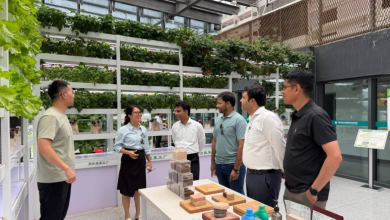
The Lahore office also installed a rooftop rainwater harvesting system paired with a groundwater recharge well. This carefully engineered setup intercepts rainfall, treats it through a systematic three-stage filtration process across three dedicated tanks, and channels the cleaned water directly into the local aquifer. Rather than allowing precipitation to run off into drains and be lost, the system actively replenishes groundwater reserves.
Given Pakistan’s accelerating groundwater depletion crisis, this initiative does more than conserve water for office use — it contributes to restoring a resource that millions of people depend on for drinking, agriculture and livelihoods. It is infrastructure that gives back to the surrounding community, not just the institution that built it.
Small Habits, Meaningful Impact
IWMI’s sustainability work also recognizes that lasting change lives in behavior — in the daily decisions made by every individual across every office. In Lahore, this is visible in small details that add up to something meaningful.
Motion-sensor lights have been installed throughout the office, automatically switching off when a space is unoccupied. Conventional energy-hungry bulbs have been replaced with energy-efficient alternatives across the board, cutting electricity consumption without any change in working comfort. Soil moisture sensors now guide drip irrigation in the office’s green spaces, ensuring water is applied only when and where it’s needed. Energy monitoring, waste reduction and sustainable procurement practices have become woven into the fabric of how IWMI operates as an institution.
Walking the Talk
There is a compelling logic underpinning all of this work. An institute that studies water stress, energy transitions and environmental sustainability must be willing to interrogate its own operations with the same rigor it applies to the systems it researches. Credibility, in this context, is earned through consistency.
When IWMI installs a solar system in Lahore and measures the kilowatts it produces, when it builds a rainwater harvesting system and traces the water it recharges into the aquifer, when it tracks and publishes its own emissions reductions — the organization is not simply reporting progress. It is demonstrating that the solutions it recommends to others are solutions it is willing to live by itself.
That, ultimately, is what it means to walk the talk.
A Living Laboratory for Sustainable Values
The work remains ongoing, and each of these steps is modest when considered in isolation. Yet together, they add up to something significant: proof that a research institution can serve as a living laboratory for the values it promotes. For partner organizations, governments and individuals watching closely, IWMI’s Pakistan office offers a tangible example of what responsible, sustainable operations can look like in practice — not as an abstract goal, but as a working reality.
Source: International Water Management Institute (IWMI).