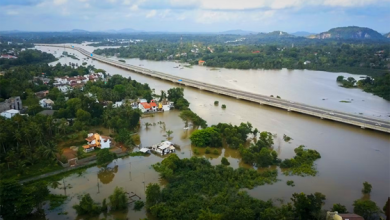

Pakistan’s NEOC Deploys Powerful AI and Drones to Brace for Deadly Monsoon Floods and Droughts
Pakistan NEOC AI drones monsoon flood disaster management — inside the nerve centre of Pakistan's National Disaster Management Authority, AI projections, satellite data from over 400 constellations, and new drone technology are being deployed to protect communities from simultaneous floods and droughts this 2026 monsoon season.
Pakistan NEOC AI drones monsoon flood disaster management — these are no longer aspirational talking points. They describe the operational reality inside Pakistan’s National Emergency Operations Center as the 2026 monsoon season bears down on one of the world’s most climate-vulnerable countries.
Rows of giant digital dashboards flicker across a darkened hall in Islamabad — satellite imagery scrolling in real time, AI projections updating, river flow charts tracked minute by minute. This is the National Emergency Operations Center (NEOC), the central nervous system of Pakistan’s disaster response architecture, operated by the National Disaster Management Authority (NDMA).
Officials here are bracing for a monsoon season shaped by El Niño — a global climate pattern that is expected to deliver above-average rainfall to Pakistan’s northern areas while exposing the southern plains to prolonged heat and agricultural stress.
For a country that watched one-third of its territory disappear underwater in 2022, the stakes could not be higher. This time, Pakistan is determined to be ready.
Inside the NEOC: Pakistan’s Disaster Command Centre
The National Emergency Operations Center is more than a monitoring facility — it is a multi-agency coordination hub that sits at the intersection of data science, disaster management, and local governance.
The NEOC monitors early warning systems across Pakistan’s entire geography — from the glacial rivers of Gilgit-Baltistan to the flood plains of Sindh. When threats are detected, it coordinates responses across a network of 83 entities — including provincial disaster management authorities, non-governmental organisations, civil administration, and military assets.
Inside the centre, a team of climatologists, AI experts, and operations managers work in shifts to ensure that Pakistan’s decision-makers have the most accurate, up-to-date picture of evolving threats — and that local authorities have what they need to act on those threats before they become catastrophes.
This level of integrated, real-time disaster monitoring is relatively new for Pakistan. It was born, largely, from the traumatic lessons of 2022.
The 2022 Floods: The Catastrophe That Changed Everything
To understand why Pakistan is investing so heavily in the Pakistan NEOC AI drones monsoon flood disaster management capability, it is necessary to understand what happened in 2022.
Heavy monsoon rains — intensified by climate change — triggered flash floods and prolonged riverine inundation across Pakistan from June to October 2022. The statistics were staggering:
- Over 1,730 people killed
- One-third of Pakistan’s territory submerged at peak inundation
- 33 million people affected — displaced, injured, or cut off from essential services
- Approximately USD28 billion in economic damage — nearly matching three decades of prior climate-related losses
The 2022 disaster exposed catastrophic gaps in Pakistan’s disaster preparedness: inadequate early warning systems, insufficient pre-positioned relief supplies, poor communication with remote communities, and a reactive rather than anticipatory approach to disaster management.
The NEOC’s current capabilities — the AI projections, the satellite networks, the drone fleets, the pre-positioned relief stocks — are the direct institutional response to those lessons. Pakistan has made a strategic decision to anticipate and prepare rather than react and recover.
El Niño 2026: Simultaneous Floods and Droughts Threaten Pakistan
The 2026 monsoon season arrives under the influence of El Niño — a periodic warming of surface temperatures in the central and eastern equatorial Pacific that triggers worldwide changes in wind patterns, atmospheric pressure, and rainfall distribution.
For Pakistan, NDMA officials warn, El Niño’s fingerprint on the 2026 monsoon will be particularly complex: the country faces the paradoxical threat of simultaneous floods in the north and droughts in the south.
This dual threat is not unprecedented for Pakistan — the country’s geography, spanning from high-altitude glacial terrain in the north to the hot, flat plains of Sindh and Balochistan in the south, creates conditions where dramatically different weather patterns can coexist.
But the El Niño amplification raises the intensity of both extremes — making the floods more severe and the droughts more prolonged than in an average year.
North vs South: A Split Monsoon Threat
Zahra Hassan, Executive Director of Technical Early Warning at the NEOC, laid out the geographic split clearly:
Northern Pakistan — Above-Average Rainfall: The northern areas are expected to receive significantly higher precipitation than last year. Key rivers under surveillance include the Shyok, Hunza, and Ghizer — all of which feed into the Indus system and are capable of generating dangerous flash floods and glacial lake outburst floods (GLOFs) when flows spike.
Southern Plains — Higher Temperatures and Agricultural Stress: Punjab, Sindh, and Balochistan face prolonged exposure to above-average temperatures. This creates severe agricultural stress — threatening crop phenological stages, accelerating evapotranspiration, and compressing the window for critical growing periods.
The consequence: food security pressures that compound the humanitarian impact of the northern floods, as both water disasters and heat-driven crop failures affect Pakistan simultaneously.
“The northern areas are going to receive above-average precipitation as compared to last year,” Hassan explained. “And the plains of Pakistan — Punjab, Sindh, and Balochistan — they are going to experience higher temperatures as compared to last year.”
400 Satellites, AI and Climatologists: How Pakistan Reads the Sky
The technological backbone of the NEOC’s early warning capability is formidable.
Pakistan’s disaster monitoring system pulls data from more than 400 satellite constellations — drawing on feeds from NASA, European, Chinese, and domestic satellite systems. This multi-source approach ensures redundancy and allows cross-validation of data, reducing the risk of blind spots or erroneous alerts.
The raw satellite data — river levels, rainfall measurements, temperature gradients, soil moisture, glacial conditions — flows into the NEOC where climatologists and AI experts translate it into actionable intelligence.
AI models process the incoming data streams to generate:
- Long-range forecasts — seasonal outlook for the monsoon period
- Mid-term alerts — week-by-week threat assessments for high-risk areas
- Immediate warnings — real-time alerts when dangerous conditions develop
This three-tier early warning architecture — long-range, mid-term, and immediate — ensures that both strategic planning (pre-positioning relief stocks, activating provincial governments) and tactical response (evacuating communities, deploying assets) are informed by the best available data.
For more on Pakistan’s climate monitoring systems, see the Pakistan Meteorological Department and NASA’s disaster monitoring resources.
Drones for the First Time: Surveillance and Relief from the Air
Perhaps the most striking new element of Pakistan’s 2026 monsoon preparedness is the deployment of drone technology — described by NDMA’s Hassan Raza as a first for Pakistan’s disaster management system.
Hassan Raza, Manager of Operations at NDMA, confirmed that both surveillance drones and relief delivery drones have been procured directly by provincial and district-level authorities and pre-positioned in high-risk zones.
The drones serve two distinct functions:
Surveillance Drones: Providing real-time aerial imagery of flood-affected areas — allowing operations managers to assess the extent of inundation, identify stranded communities, track river levels, and guide rescue operations without putting personnel at risk in dangerous conditions.
Relief Delivery Drones: Capable of carrying and dropping essential items — food packages, medicines, hygiene supplies — to communities cut off by floodwaters where road and helicopter access is impossible or too slow.
“For the first time, we have provided modern technology like drones and helicopters for these areas,” Raza confirmed. The integration of unmanned aerial systems into Pakistan’s disaster response toolkit represents a significant leap in both reach and speed.
Pre-Positioned Relief: 17 Items Ready Before Disaster Strikes
One of the most operationally significant changes in Pakistan’s 2026 monsoon preparedness is the pre-positioning of emergency assets in high-risk zones before disaster strikes.
NDMA has pre-positioned 17 basic relief items across vulnerable areas — ensuring that when floods hit, communities do not have to wait for supplies to travel from central warehouses. The inventory is in place, close to where it will be needed, ready for immediate distribution.
This approach directly addresses one of the most painful lessons of 2022: the delays in getting aid to affected communities in the critical early days after disaster, when mortality and suffering are highest.
Pre-positioned relief supplies typically include:
- Food rations and drinking water
- Tents and tarpaulins for temporary shelter
- Blankets and sleeping mats
- Hygiene kits
- First aid and medical supplies
By eliminating transit time from the response equation, pre-positioning can mean the difference between relief reaching a community in hours rather than days — saving lives and preventing the secondary health crises that compound disaster impacts.
Early Warnings in 8 Languages: Reaching Every Community
Sophisticated data and advanced technology are only as effective as their ability to reach the people who need to act on them. The NEOC has designed its alert systems with this challenge explicitly in mind.
When a threat is detected, alerts are simultaneously broadcast to 83 entities — spanning NGOs, provincial disaster management authorities, civil administration, and emergency services.
At the community level, the NDMA’s dedicated mobile application broadcasts audio warnings in eight regional languages — ensuring that alerts reach populations who may not read Urdu or English and who rely on voice communication.
Beyond digital channels, local networks including mosques and churches are incorporated into the early warning chain — recognising that in Pakistan’s diverse and often rural communities, religious institutions remain among the most trusted and reliable communication nodes.
“Local networks will make announcements through mosques and churches to reach vulnerable communities,” Raza confirmed — a pragmatic acknowledgment that the most sophisticated satellite data is worthless if the warning doesn’t reach the farmer in the field or the family in the flood plain.
KP’s Ground-Level Network: Down to the Village Headman
Among Pakistan’s provinces, Khyber Pakhtunkhwa (KP) is expected to be the hardest hit by the 2026 monsoon season — given its northern geography, mountainous terrain, and exposure to the rivers flowing from glacial regions.
The KP government has responded by building what Raza describes as a “strong network” for coordinated action — extending the early warning and response chain all the way down to the most granular level of local governance.
“The KP government has listed people down to the union council and numberdar (village headman) level and connected them with us online,” Raza explained.
This hyper-local connectivity is genuinely significant. In past disasters, the breakdown between provincial coordination and village-level action has been one of the most dangerous gaps — warnings issued at the provincial level that never reached the communities in danger.
By digitally connecting village headmen directly to the NDMA’s coordination system, KP has created a two-way channel: early warnings flowing downward to communities, and ground-level situation reports flowing upward to decision-makers in real time.
This model — if it functions as designed — represents the kind of last-mile connectivity that could save many lives in the coming monsoon season.
Conclusion: From Reaction to Anticipation — Pakistan’s New Disaster Doctrine
The Pakistan NEOC AI drones monsoon flood disaster management story is ultimately a story about institutional learning under the most painful of circumstances.
The 2022 floods did not just kill 1,730 people and inundate a third of the country — they forced a fundamental rethink of how Pakistan manages natural disasters. The shift that resulted — from reactive response to anticipatory preparedness — is now visible in every aspect of the NEOC’s operations.
In the satellite feeds from 400 constellations. In the AI models processing climate data into actionable alerts. In the drones pre-positioned in KP’s mountain districts. In the 17 relief items already stocked in high-risk zones. In the eight-language audio warnings reaching farmers in remote valleys. In the village headmen connected online to the national command centre.
Pakistan has not solved its climate vulnerability. El Niño will still bring floods to the north and heat to the south. Glaciers will still calve into lakes. Monsoon rains will still overwhelm drainage systems designed for a different climate.
But Pakistan is no longer waiting to be caught unawares. The NEOC is watching — and this monsoon season, it is ready.