
Water Cycle Instability Poses Major Global Economic Risk — Report
New analysis warns that global water cycle disruption threatens energy, trade, and sovereign debt sustainability, with GDP losses projected by 2050.
A growing body of evidence suggests that the world’s water cycle — long treated as a stable backdrop for economic activity — has become one of the most underestimated risks facing governments, industries, and investors worldwide. According to the Global Commission on the Economics of Water (GCEW), the hydrological cycle is now “out of balance” for the first time in recorded human history, a shift with consequences reaching far beyond agriculture and into energy markets, global trade, and national finances.
The GCEW, convened by the Government of the Netherlands with its secretariat hosted by the International Water Management Institute (IWMI) since 2025, brings together leading figures in climate science, international trade, and economic governance. Its findings, echoed in the World Bank’s recent report Continental Drying: A Threat to Our Common Futures, describe a “dangerous decline in freshwater availability” driven by decades of undervaluation, mismanagement, and intensifying climate pressures.
Why Water Has Become an Economic Flashpoint
For most of modern economic history, water was treated as an abundant, low-cost input — available wherever industry, agriculture, or cities needed it. Infrastructure planning, energy generation, and supply chains were built on the assumption that rainfall patterns, river levels, and aquifers would remain broadly predictable.
That assumption is now collapsing. Rising global temperatures are altering precipitation patterns, accelerating evaporation, and drying out aquifers at a pace that outstrips natural replenishment. At the same time, demand for water is climbing sharply, driven not only by traditional users such as agriculture, municipal supply, and industry, but increasingly by energy-intensive digital infrastructure — most notably the artificial intelligence (AI) data centers now being built across Europe and beyond.
This convergence of shrinking supply and expanding demand means that water stress is no longer confined to drought-prone regions. It is now surfacing in some of the world’s most industrialized economies, disrupting sectors that had rarely considered water a strategic vulnerability.
Power Generation Under Strain
Thermoelectric power plants — including coal, gas, and nuclear facilities — rely heavily on water for cooling. When river levels fall or water temperatures rise beyond regulatory thresholds, operators are legally required to scale back or halt production to prevent thermal pollution of waterways.
This is not a hypothetical scenario. During the European heatwaves of 2018 and 2022, France’s Électricité de France (EDF) was forced to curtail nuclear output, while German coal-fired plants slowed operations to comply with environmental limits. These episodes illustrate how water scarcity can directly translate into energy shortfalls, with knock-on effects for electricity prices and industrial output.
Insurance markets are already pricing in this risk. Data from global reinsurers Munich Re and Swiss Re indicate that water-related losses have become the leading driver of rising uninsured natural catastrophe costs across Europe — a trend that, left unaddressed, threatens to push critical infrastructure toward uninsurability, with serious implications for credit risk.
Trade Routes and Supply Chains at Risk
Europe’s inland waterways — including the Rhine, Danube, and Elbe — serve as essential arteries for transporting chemicals, fuels, construction materials, and automotive components. During the low-water events of 2018 and 2022, per-tonne freight costs on these routes rose by a factor of two to four, as large cargo vessels became unable to navigate key stretches of river.
Such disruptions are increasingly viewed not as isolated weather events but as structural risks that must be factored into infrastructure planning, just-in-time supply chain design, and industrial site selection going forward.
The AI Factor
Adding further pressure is the rapid expansion of AI data centers, many of which are being sited across Europe. These facilities are highly water- and power-intensive, placing them in direct competition with existing industrial, agricultural, and municipal users for the same limited resources — often within the same river basins and during the same seasonal windows.
Mispriced Water, Mounting Costs
A central theme in the GCEW’s analysis is the role of pricing failures in accelerating the crisis. Globally, more than $700 billion is funneled annually into water and agricultural subsidies, with energy subsidies in many countries compounding the strain on water systems. This underpricing makes water-intensive production in already water-scarce regions appear economically viable, even as it drains resources unsustainably. Agricultural regions alone are estimated to be losing roughly 13.2 cubic kilometers of groundwater every year — a scale of depletion the Commission characterizes as a policy failure.
Rethinking Sovereign Risk
International financial institutions are also being urged to update their models. Current debt sustainability analyses and fiscal stress tests largely assume stable water availability — an assumption the GCEW argues no longer holds. The Commission is calling for water risk to be formally integrated into Resilience and Sustainability Facility conditionalities, sovereign debt assessments, and central bank scenario planning.
El Salvador has already moved in this direction, pioneering a debt-for-water swap that redirects fiscal resources toward hydrological resilience — a model that could offer a template for other vulnerable economies.
The Commission also points to “virtual water trade” — tracking the hidden water embedded in traded goods and services — as a potential tool for steering water-intensive production toward regions that use water more efficiently.
A Political, Not Just Technical, Challenge
Ultimately, the GCEW stresses that decisions about water allocation are inherently political. Choices between cities and farmers, industries and rural communities, or current and future generations reflect underlying questions of power and priority within regulatory systems.
The economic stakes are substantial. By 2050, the Commission projects that continued disruption to the water cycle could shrink GDP in high-income countries by 8%, and by 10% to 15% in lower-income countries — a macroeconomic drag affecting growth, debt sustainability, fiscal capacity, investor confidence, and food security simultaneously.
Report Link: economics-of-water.pdf
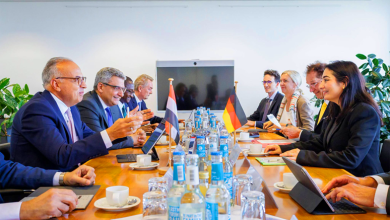
This report is based on remarks delivered by Rachael McDonnell, Deputy Director General of the International Water Management Institute (IWMI), at the Handelsblatt Conference “Wirtschaftsfaktor Wasser” (Water as an Economic Factor), held June 24, 2026, in Berlin, Germany.