

HEC Empowers Pakistani Academic With Breakthrough Livestock Disease Prevention Training in China
HEC livestock disease prevention training Pakistan China — Dr Muhammad Haris from University of Poonch Rawalakot completed a powerful three-month programme at Northwest Agriculture and Forestry University in China under PM's capacity-building initiative, gaining cutting-edge skills in disease surveillance, biosecurity, and animal nutrition.
HEC livestock disease prevention training Pakistan China — this initiative represents exactly the kind of targeted, high-impact investment in human capital that Pakistan’s agricultural sector urgently needs.
With the support of the Higher Education Commission (HEC) under the Prime Minister of Pakistan’s capacity-building initiative for agriculture and livestock graduates, Dr Muhammad Haris — Lecturer in Animal Nutrition at the University of Poonch Rawalakot, Azad Jammu & Kashmir — has successfully completed a rigorous three-month specialised training programme at the prestigious Northwest Agriculture and Forestry University (NWAFU) in Yangling, China.
The programme, which covered modern livestock disease surveillance, biosecurity, laboratory diagnostics, animal nutrition, and farm management, has equipped Dr Haris with cutting-edge knowledge and practical skills that he is now positioned to bring back to Pakistan’s academic institutions, research ecosystem, and farming communities.
This is the story of one scholar — but its impact is designed to multiply across students, farmers, and the broader livestock sector of Azad Jammu & Kashmir and beyond.
About Dr Muhammad Haris and the University of Poonch Rawalakot
Dr Muhammad Haris serves as a Lecturer in Animal Nutrition at the University of Poonch Rawalakoti — a public university located in Rawalakot, the administrative capital of Azad Jammu & Kashmir (AJK).
Animal nutrition is a foundational discipline in livestock science — understanding how feed composition, feeding strategies, and nutritional balance affect animal health, productivity, and disease resistance. For a region like AJK, where livestock farming is deeply embedded in rural livelihoods and the mountainous terrain creates specific challenges for feed availability and disease management, expertise in animal nutrition has direct, practical consequences for farming communities.
Dr Haris’s selection for this prestigious international training programme reflects both his professional standing and the HEC’s strategic focus on strengthening capacity in agriculture and livestock sciences at institutions outside Pakistan’s major urban centres.
By investing in academics at regional universities like the University of Poonch Rawalakot, HEC is extending the reach of Pakistan’s knowledge economy into communities that most need it.
The PM’s Capacity-Building Initiative: Building Pakistan’s Agricultural Future
The training was funded under the Prime Minister of Pakistan’s capacity-building initiative for agriculture and livestock graduates — a programme that reflects the government’s recognition that Pakistan’s agricultural sector requires sustained investment in human capital, not just infrastructure and inputs.
Agriculture contributes approximately 25 percent of Pakistan’s GDP and employs 40 to 50 percent of the workforce. Livestock alone accounts for roughly 60 percent of agriculture’s value-added — making it the single largest sub-sector of Pakistan’s economy.
Yet Pakistan’s livestock sector faces serious structural challenges:
- Disease outbreaks — including foot-and-mouth disease, lumpy skin disease, and avian influenza — regularly devastate herds and poultry flocks
- Weak disease surveillance systems that fail to detect and contain outbreaks early
- Limited biosecurity practices at farm level
- Inadequate laboratory diagnostic capacity to identify pathogens accurately and quickly
- Knowledge gaps among farmers about nutrition, disease prevention, and farm management
Sending agricultural and livestock academics abroad for specialised training — and then having them return to teach, train, and research — is one of the most cost-effective strategies for addressing these structural gaps at scale.
For more on HEC’s international scholarship and training programmes, visit the Higher Education Commission of Pakistan.
Northwest Agriculture and Forestry University: A World-Class Training Host
The choice of Northwest Agriculture and Forestry University (NWAFU) in Yangling, Shaanxi Province, as the host institution reflects a deliberate pairing of Pakistan’s learning needs with China’s agricultural excellence.
NWAFU is one of China’s leading comprehensive agricultural universities, with particular strengths in:
- Animal science and veterinary medicine
- Plant science and crop protection
- Agricultural water and land resources
- Food science and biosafety
Yangling itself is home to China’s first national agricultural high-tech industry demonstration zone — making it a hub of agricultural innovation, research, and applied technology. Training in this environment exposes participants not just to academic knowledge but to real-world implementation of advanced agricultural systems.
For Pakistan’s agricultural academics, exposure to China’s integrated approach to livestock disease management — which combines traditional knowledge with modern surveillance technology, genomics-based diagnostics, and precision farm management — is genuinely transformative.
For more on NWAFU, visit the Northwest Agriculture and Forestry University official website.
What the Three-Month Programme Covered
The Yangling training was designed as a comprehensive, multi-disciplinary programme covering the full spectrum of modern livestock disease monitoring and prevention. Key areas included:
Modern Disease Surveillance Systems
Participants learned the architecture of integrated disease surveillance — from field-level reporting by farmers and village veterinarians, to regional data aggregation, to national early warning systems. China’s experience with large-scale disease surveillance — hardened through responses to African Swine Fever, avian influenza, and other outbreaks — provided a powerful practical reference.
Biosecurity Measures
Biosecurity — the set of practices that prevent the introduction and spread of disease agents into and within livestock operations — was a central focus. Participants gained knowledge of farm-level biosecurity protocols, movement controls, visitor management, and disinfection procedures.
Laboratory Diagnostic Techniques
Modern disease management depends on rapid, accurate laboratory diagnosis. The programme covered molecular diagnostic techniques including PCR, ELISA, and culture-based methods — giving participants the practical skills to identify pathogens quickly and support outbreak response.
Animal Nutrition
Building on Dr Haris’s core expertise, the training deepened his understanding of how nutritional status affects disease susceptibility — and how optimised feeding strategies can strengthen animal immune function and reduce disease incidence.
Innovative Farm Management Practices
The programme introduced participants to precision livestock farming — the use of sensors, data analytics, and digital platforms to monitor animal health, optimise feed conversion, and detect disease signs early.
Hands-On Learning: Field Visits and Practical Demonstrations
A distinctive feature of the Yangling programme was its integration of classroom learning, field visits, and practical demonstrations — ensuring that participants did not merely absorb theoretical knowledge but applied it directly.
Field visits to Chinese livestock farms — operating at scales and with technological integration rarely seen in Pakistan — gave participants direct exposure to how advanced disease surveillance and biosecurity systems function in practice. Seeing a functioning integrated farm management system, a modern veterinary diagnostic laboratory, or an automated biosecurity checkpoint in operation makes abstract knowledge concrete and actionable.
Practical demonstrations — using actual laboratory equipment, participating in mock disease outbreak simulations, handling diagnostic tools — built the technical competence that classroom instruction alone cannot provide.
This hands-on design reflects adult learning best practice: professionals learn most effectively when they can connect new knowledge to real problems and practise new skills in realistic settings. 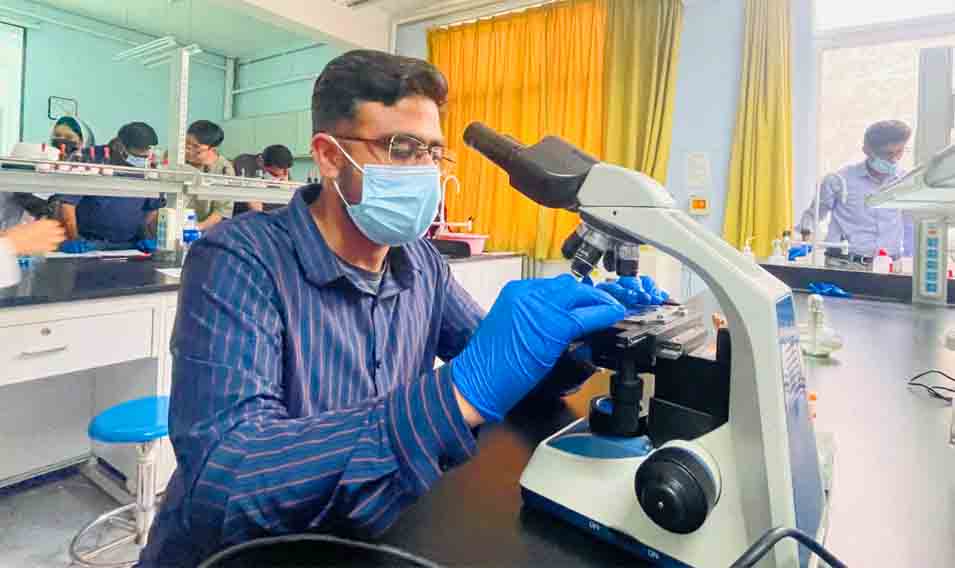
International Collaboration: Knowledge Exchange Across Borders
The Yangling programme was an international training event — bringing together participants from diverse academic and professional backgrounds across multiple countries.
For Dr Haris, this created a valuable secondary dimension to the learning experience: peer-to-peer knowledge exchange.
Engaging with fellow participants from different countries — each bringing their own context, challenges, and approaches to livestock disease management — broadened Dr Haris’s understanding of how the same problems are tackled in different settings. Collaborative problem-solving, research discussions, and shared field experiences created professional connections that will outlast the formal programme.
Dr Haris also served as an ambassador for Pakistan — representing his country’s agricultural community, sharing Pakistan’s approaches and challenges, and building relationships that could support future research collaboration between Pakistani and international institutions.
Impact for Azad Jammu & Kashmir’s Livestock Sector
For Azad Jammu & Kashmir, Dr Haris’s enhanced expertise carries particular significance.
AJK’s economy is heavily dependent on agriculture and livestock. The region’s mountainous terrain, combined with limited veterinary infrastructure and difficult access to inputs, makes livestock disease outbreaks especially damaging for rural communities.
A single outbreak of foot-and-mouth disease or lumpy skin disease in AJK’s cattle population can devastate household incomes, disrupt milk and meat supply chains, and push vulnerable families deeper into poverty. Early detection, rapid response, and effective biosecurity are the difference between a manageable disease event and a community-level crisis.
Dr Haris’s return to the University of Poonch Rawalakot — equipped with modern disease surveillance knowledge, laboratory diagnostic skills, and innovative farm management expertise — positions him to:
- Train veterinary and animal science students with up-to-date, internationally benchmarked knowledge
- Advise farmers in AJK on biosecurity and disease prevention practices
- Strengthen the research capacity of his university in livestock health sciences
- Collaborate with AJK’s provincial veterinary services to improve outbreak response
Pakistan’s Livestock Sector: Why This Training Matters Nationally
The HEC livestock disease prevention training Pakistan China programme is not just about one academic’s professional development. It is part of a national strategy to strengthen Pakistan’s livestock sector from the ground up — by investing in the people who train the next generation of veterinarians, animal scientists, and agricultural professionals.
Pakistan’s livestock challenges are significant:
- Foot-and-mouth disease causes annual economic losses estimated in the billions of rupees
- Lumpy skin disease has emerged as a growing threat to Pakistan’s cattle population
- Avian influenza periodically devastates the poultry sector, which is a critical source of affordable protein
- Brucellosis — a bacterial disease affecting cattle, buffalo, goats, and sheep — is widespread and poses a zoonotic risk to human health
Addressing these challenges requires a pipeline of well-trained professionals who understand modern disease surveillance, can operate advanced diagnostic equipment, and can design and implement biosecurity systems. Programmes like the PM’s capacity-building initiative — and placements like Dr Haris’s at NWAFU — are investing in building that pipeline.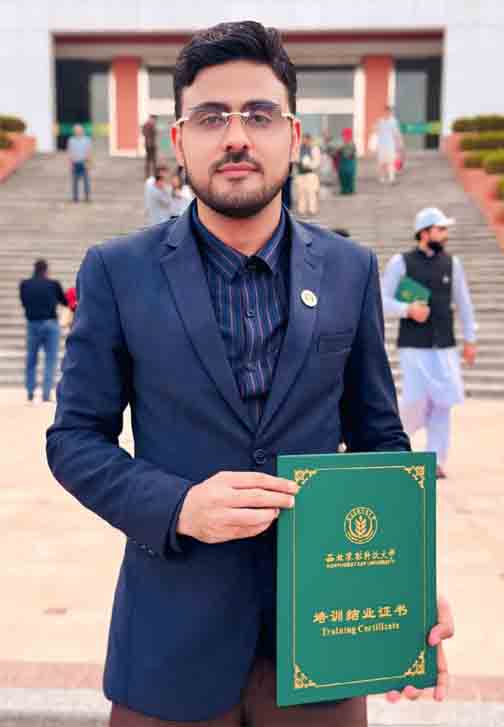
For more on Pakistan’s livestock sector, visit the Ministry of National Food Security and Research and the Food and Agriculture Organization’s livestock resources in Pakistan.
Dr Haris’s Plans: From China’s Classrooms to Pakistan’s Farms
Dr Haris returned from Yangling with a clear vision for applying his newly acquired knowledge.
He plans to channel his training into three priority areas:
Promoting Sustainable Livestock Development Applying the integrated farm management and nutritional principles learned in China to support more productive, disease-resistant, and environmentally sustainable livestock production in AJK and the broader Pakistani context.
Strengthening Disease Prevention Capacity Working with university students, extension services, and farming communities to disseminate practical biosecurity and disease surveillance knowledge — translating international best practice into locally applicable tools and approaches.
Capacity Building for Students and Farmers Designing and delivering training programmes — in academic and field settings — that build the next generation of livestock health professionals and equip farmers with the knowledge they need to protect their animals and their livelihoods.
Dr Haris expressed sincere gratitude to the Government of Pakistan, the Higher Education Commission, and the Ministry of National Food Security and Research for providing this transformative international learning opportunity — and committed to ensuring that the investment made in his training yields returns for Pakistan’s farming communities.
Conclusion: One Scholar, Multiplying Impact
The HEC livestock disease prevention training Pakistan China programme — as embodied by Dr Muhammad Haris’s three-month journey to Yangling — is an investment whose returns will compound over time.
One academic, trained in modern disease surveillance and biosecurity. Returning to a university in Azad Jammu & Kashmir. Teaching dozens of students each year. Advising farmers across the region. Building research partnerships with international institutions. Informing policy through better evidence.
The impact of this single training placement — multiplied through Dr Haris’s teaching, research, and community engagement over the years ahead — will touch far more than 300 families or 3 months of learning.
It will touch the students who study animal science under his guidance. The farmers who learn biosecurity practices from his workshops. The veterinary graduates who enter practice better equipped to prevent and contain disease outbreaks. The AJK communities whose livestock — and livelihoods — are protected by more effective disease management.
This is what strategic investment in human capital looks like. And Pakistan needs much more of it.