

BYD, Mega Motors Move Pakistan Towards Sustainable Mobility
Chinese electric vehicle giant and a global frontrunner in electric vehicles, BYD, launched car production plant in Karachi city of Pakistan, a cooperation partner of China’s BRI.
- BYD and Mega cooperation partnership is a profound commitment to fostering sustainable mobility and environmental stewardship in Pakistan.
By: Muhammad Arif, Editor NSN.Asia
Islamabad: Chinese electric vehicle giant and a global frontrunner in electric vehicles, BYD, in partnership with Mega Motors, has launched EV car production plant in Karachi city of Pakistan, a cooperation partner of China’s BRI.
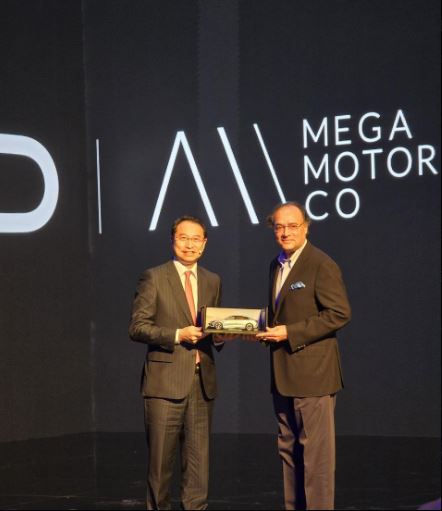
BYD will sell three models through a cooperation partnership with Mega Motors.
“Our entry into the Pakistani market is not just about bringing advanced vehicles to consumers,” said Liu Xueliang, BYD’s general manager for Asia Pacific while Speaking to news agency, Reuters.
The launching ceremony of BYD was attended by Federal Minister for Finance and Revenue, Senator Muhammad Aurangzeb.
By bringing renewable energy solutions in Pakistan, BYD becomes the first major new electric vehicle (NEV) automaker in the Pakistan’s bustling automobile market.
While articulating the BYD’s mission to mitigate global warming, Liu Xueliang, General Manager of BYD Asia Pacific Auto Sales Division, said, “this collaboration with Mega serves as a testament to a mutual ambition for a sustainable future, aiming to revolutionize Pakistan’s automotive industry with cutting-edge new energy vehicle solutions”.
Aly Khan, Executive Director of Mega, expressing Mega’s enthusiasm for cooperation partnership with BYD stated “the initiative will commence with the launch of BYD flagship showrooms in Karachi, Lahore, and Islamabad in 2024, designed to immerse customers in BYD’s premium new energy vehicle technology and provide a distinctive retail experience, including the facilitation of direct orders. Khan emphasized the synergistic potential of combining Mega’s and BYD’s resources to spur the adoption of EVs, heralding a sustainable mobility era”.
Automobile experts view the BYD and Mega cooperation partnership as a profound commitment to fostering sustainable mobility and environmental stewardship in Pakistan.
The launching of EV production plant in Karachi by BYD, the vanguard of power battery technology and eco-friendly innovations, marks a monumental stride towards electric mobility, orchestrating a paradigm shift towards a greener, more sustainable transportation framework within the nation.