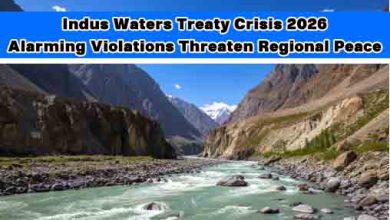

India Using Indus Waters Treaty as Weapon to Trigger Food Insecurity in Pakistan, Experts Warn
Experts warn India is using the Indus Waters Treaty as a tool of water aggression, threatening Pakistan’s agriculture, food security, and climate resilience.
Pakistan’s food security depends almost entirely on the uninterrupted flow of river water from the Indus Basin, which sustains agriculture for nearly 250 million people. Experts warn that India’s actions under the Indus Waters Treaty (IWT) increasingly resemble water weaponization, threatening crops, livelihoods, and national stability.
Signed in 1960 with the World Bank as guarantor, the treaty allocated the western rivers — Indus, Jhelum, and Chenab — to Pakistan, while India received control over the eastern rivers — Ravi, Beas, and Sutlej.
Why the Indus Waters Treaty Matters
Economists and water experts describe the IWT as the backbone of Pakistan’s irrigation system.
Water Allocation Breakdown:
| River System | Country Allocation | Annual Share |
|---|---|---|
| Western Rivers (Indus, Jhelum, Chenab) | Pakistan | ~133 MAF |
| Eastern Rivers (Ravi, Beas, Sutlej) | India | ~35 MAF |
Experts note that Pakistan was granted nearly 80% of basin water, reflecting its agricultural dependence.
Alleged Dam Construction Violating the Treaty
Water analysts say India has:
- Built 15+ dams on western rivers
- Planned 45–61 additional projects
- Initiated irrigation schemes worth $15 billion
Major projects flagged include:
Kishanganga Hydropower Project
Ratle Dam
Pakal Dul Project
Sawalkot Power Plant
Wular Barrage
While presented as energy initiatives, experts argue they enable flow manipulation — a strategic tool capable of triggering water shortages downstream.
Food Insecurity Risks Rising
Historically, Pakistan received around 19 million acre-feet annually from eastern rivers. Today, inflows have dropped below 300,000 acre-feet due to upstream diversions.
This has already:
Reduced irrigation capacity
Increased crop stress
Worsened water scarcity
Raised food prices
Any interference in western rivers would pose an even more severe threat to Pakistan’s wheat, rice, cotton, and sugarcane production.
International Law and Treaty Violations
Legal experts highlight that:
- The treaty has no suspension clause
- Unilateral action violates the Vienna Convention on Treaties
- The Permanent Court of Arbitration (2025 ruling) affirmed India cannot suspend IWT mechanisms
The World Bank has repeatedly maintained the treaty remains legally binding.
Climate Change Intensifying the Crisis
With glaciers melting, erratic monsoons, and rising drought risk, Pakistan’s water vulnerability is already extreme.
Weaponizing river flows amid climate stress could:
Collapse crop yields
Intensify water shortages
Destabilize rural economies
Trigger humanitarian pressures
Experts warn water conflict in a warming region is one of South Asia’s most dangerous geopolitical flashpoints.
Regional Stability at Stake
Former diplomats and security analysts stress that:
- Water coercion undermines peace frameworks
- Sets dangerous global precedents
- Threatens international water law credibility
The Indus Waters Treaty has survived wars — its erosion could destabilize the entire region.
Call for Global Oversight
Experts urge:
Strong World Bank intervention
UN monitoring of treaty compliance
Climate diplomacy support
Enforcement of arbitration rulings
They warn silence could normalize water aggression as a geopolitical weapon.
Final Thought
The Indus Waters Treaty was designed to ensure cooperation even during conflict. Turning it into a tool of pressure threatens:
Food security
Water rights
Regional peace
Climate resilience
For Pakistan, safeguarding river flows is not just a diplomatic issue — it is a survival imperative.