
Historic Leap: Pakistan Launches New Remote Sensing Satellite from China in Strategic Space Collaboration
Pakistan launches new remote sensing satellite from China in SUPARCO-led mission, enhancing Earth observation, disaster response, and climate monitoring.
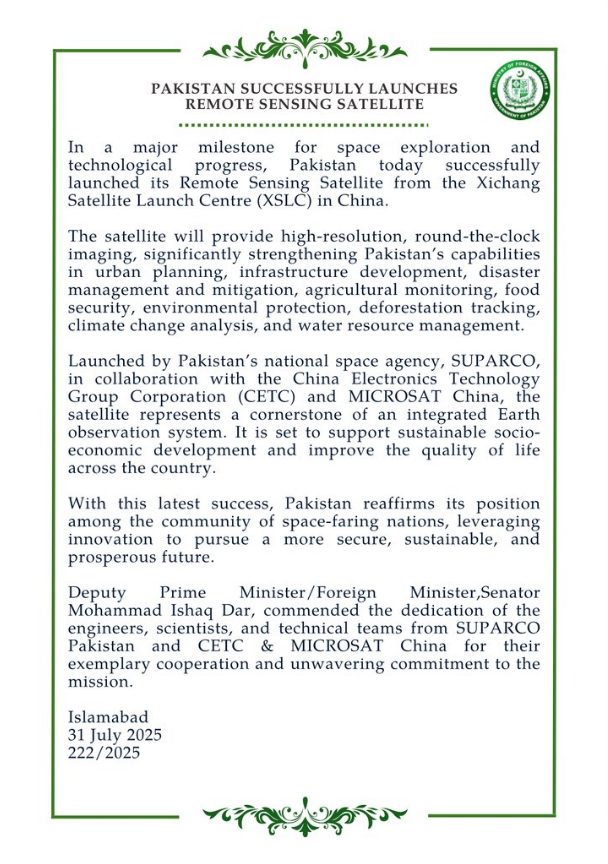
Pakistan launches new remote sensing satellite — a transformative event that symbolizes technological progress and strategic partnership. On July 31, 2025, Pakistan successfully launched a state-of-the-art Earth observation satellite from China’s Xichang Satellite Launch Centre (XSLC). The mission was spearheaded by SUPARCO, Pakistan’s national space agency, in collaboration with China Electronics Technology Group Corporation (CETC) and MICROSAT China.
This launch marks a bold step forward in Pakistan’s space exploration ambitions and its socio-economic development strategy.
The Launch Event
On Thursday, China’s Kuaizhou-1A carrier rocket roared into the skies from the Xichang Satellite Launch Center in Sichuan, carrying Pakistan’s latest remote sensing satellite into orbit. This marked the 29th successful flight of the Kuaizhou-1A rocket, known for its efficiency in launching small satellites.
According to Pakistan’s Ministry of Foreign Affairs, the satellite is already in its planned orbit and functioning optimally.
“This achievement reaffirms Pakistan’s standing in the community of spacefaring nations,” said the Foreign Office in a press statement.
Partnership with China
This mission further strengthens the Pakistan–China strategic partnership, especially in science and technology. The collaborative efforts between SUPARCO, CETC, and MICROSAT represent a deepening of space cooperation.
Minister for Planning and Development Ahsan Iqbal emphasized this sentiment on his official X (formerly Twitter) handle:
“This accomplishment not only strengthens our space exploration capabilities but also takes the Pakistan–China iron brotherhood beyond the skies.”
China’s support, both technical and logistical, has been instrumental in launching several Pakistani satellites, starting from PakSat-1R to PRSS-1 and now this advanced remote sensing mission.
Learn more about China’s space capabilities
Key Capabilities of the Satellite
The remote sensing satellite is designed for high-resolution, round-the-clock Earth observation. It will serve critical functions in:
-
Disaster Management
-
Urban and Infrastructure Planning
-
Environmental Protection
-
Agricultural Monitoring
-
Food Security Enhancement
-
Climate Change Analysis
-
Water Resource Management
The satellite is part of an integrated Earth observation system that will help Pakistan manage climate vulnerabilities and natural disasters more proactively.
This includes improvements to early warning systems for floods, earthquakes, and crop diseases—an urgent necessity in the face of Pakistan’s escalating climate risks.
SUPARCO’s Role and National Pride
SUPARCO (Space & Upper Atmosphere Research Commission) led the mission with a commitment to scientific excellence and innovation.
Deputy Prime Minister and Foreign Minister Senator Ishaq Dar praised the SUPARCO engineers and technical teams for their “exemplary cooperation and unwavering commitment.”
“This launch is a proud milestone for Pakistan’s growing space ambitions.”
The success is seen as a morale booster for Pakistan’s scientific community and a step toward self-reliance in strategic technologies.
Implications for Pakistan’s Development
With this satellite in orbit, Pakistan can now:
-
Monitor deforestation and glacier retreat in the Hindu Kush-Himalaya region
-
Track urban expansion in megacities like Karachi and Lahore
-
Assess crop yields and predict locust swarms using NDVI (Normalized Difference Vegetation Index)
-
Oversee large-scale infrastructure projects under CPEC (China–Pakistan Economic Corridor)
These capabilities will directly impact sectors like agriculture, urban development, energy, and disaster preparedness, helping Pakistan meet its Sustainable Development Goals (SDGs).
The Pakistan–China Space Alliance
This mission reflects the resilience of Pakistan–China relations, often described as “Iron Brotherhood.” The satellite launch adds another layer to their strategic cooperation in:
-
Belt and Road Initiative (BRI)
-
Energy and Nuclear Projects
-
Science and Innovation
This also sets the stage for future co-development of satellites, shared data platforms, and even space exploration missions—a potential game-changer for Pakistan’s space future.
Explore the Belt and Road Initiative
Use of AI and Big Data
The satellite’s data will be integrated with AI-driven analytics for:
-
Climate modeling
-
Urban traffic optimization
-
Precision agriculture
-
National security surveillance
This introduces smart governance possibilities, particularly in managing urban sprawl, flood risks, and resource allocation.
Conclusion
Pakistan launches new remote sensing satellite — a momentous event that pushes national boundaries in space, science, and strategic diplomacy. This successful mission not only amplifies SUPARCO’s credibility but also showcases Pakistan’s growing prowess in high-tech global partnerships.
The launch marks a powerful step toward achieving climate resilience, technological self-sufficiency, and scientific excellence. More importantly, it cements Pakistan’s position among spacefaring nations with a clear path toward a smarter, data-driven future.