
Women survived Pakistan’s floods but face worsening health crisis
Source: Al Jazeera, Date: 9 Nov, 2022
Hundreds of thousands of women are still struggling with reproductive issues and spiralling mental health concerns.
Islamabad, Pakistan – It has been two weeks since Hasina Mugheri returned to her village in Pakistan’s southern province of Sindh, which was devastated by unprecedented floods in August.
Each day, Mugheri relives the trauma of the night that she and her family were forced to evacuate from their home in the village of Khair Muhammed Mugheri because of the rising, rushing floodwaters. She was 10-weeks pregnant.
“We did eventually manage to find [a] roof over our heads, so I am very grateful to god for that,” said the 42-year-old.
“But it cost me my child.”
Mugheri narrated how she, her husband and 21 members of their household spent the night out in the open, before walking more than five kilometres (three miles) in the rain and darkness to reach a government school in the city of Johi where they found shelter.
“Within two days of reaching there, I started bleeding, and asked my husband to take me to the hospital. The doctors said that stress, and all the walking perhaps caused the loss of [my] pregnancy. But what else can I do now, except praying,” Mugheri told Al Jazeera.
For Mugheri, the loss of her pregnancy was a painful reminder of the last major flood in her village in 2010. Then, too, she lost a child who was only seven-days old.
The repeated trauma has sent her spiralling into depression, she said.
“I last had a daughter nine years ago. I have already endured multiple miscarriages. You always hope for the best and are looking forward to become a mother again but then things like this happens,” she recalled.
“I was just completely bedridden in a room full of people, with no privacy, and no space to grieve.”
One in five million women
Mugheri is one of the five million women of reproductive age who are currently living in squalid conditions in Pakistan’s flood-affected areas, with a vast majority in the worst-hit province of Sindh.
According to the United Nations Population Fund (UNFPA), as of November 10, more than 400,000 women are currently pregnant in the flood-affected regions of Pakistan, with another 136,000 women expected to give birth in the next three months.
Dr Nighat Shah, a women’s health specialist associated with Karachi’s Aga Khan Hospital, said that more than maternal and reproductive health issues, it is their mental health that concerns her the most.
“We have gone to multiple camps across Sindh where thousands of women are stranded, living in awful conditions, and the displacement has caused immense trauma to them,” she told Al Jazeera.
Counting the cost
At least 1,739 people, including 647 children, have died and 33 million people were affected after record-breaking rains began lashing Pakistan in June, according to the country’s disaster management authority.
Sindh and the adjoining province of Balochistan remain the worst hit, with 799 and 336 deaths, respectively.
At their peak, the floods, caused by a “monsoon on steroids” as described by the United Nations chief Antonio Guterres, left more than one-third of the country submerged.
It resulted in damage to more than 13,000km (8,000 miles) of road networks as well as more than two million houses, which were either partially or completely destroyed. A million livestock was lost as well as thousands of acres of agricultural land.
According to the Post-Disaster Needs Assessment report prepared by the government, with assistance from the UN and other international organisations, the total damage is estimated to exceed $14.9bn, and total economic losses to reach about $15.2bn.
Daily struggles continue
But for thousands of women like Mugheri, it is the daily struggles that overshadow the big numbers and systemic, infrastructure issues.
Tasmina, a 25-year-old mother of two, said she had no choice but to sell her wedding ring, a gift from her mother, to buy medicines for her family and herself.
She said her husband and children suffered from malaria, while she was down with gastroenteritis, when they were living in a camp for displaced people near Johi city in Sindh.
“My ring, which was a wedding present from my mother was worth 10,000 rupees ($44). But when we all fell sick, I did not have money to buy medicines. I ended up selling it for 3,500 rupees ($15),” she told Al Jazeera.
Recalling her time at the camp where she spent more than two months, Tasmina said the conditions were horrific, with no sanitation services or hygiene, as hundreds of men and women were forced to use the same temporary toilet facilities, with limited water.
“When I got [my] periods, it became even more difficult and embarrassing for me. There was no segregation, no clean cloth was available, and not enough water to wash what I had with me. Just thinking about that time is making me cry. Only god is our witness how we spent those days,” she told Al Jazeera.
Women suffered the most
Raheema Panhwar, the provincial coordinator for WaterAid, a non-profit group that works in the area of sanitation and hygiene, told Al Jazeera that while the floods inflicted pain and misery across communities, it was the women who often suffered the most.
“Many girls face trauma and anxiety, particularly those who started their periods for the first time. They feel shame and fear because they don’t have any knowledge how to manage their periods. And there is no adequate support from the family due to circumstances,” she said.
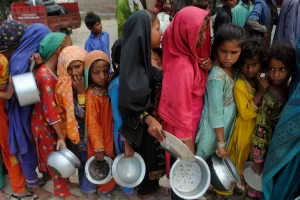
Women have suffered anxiety and trauma, which is often reflected in the various ailments they face, he said.
“We have directed a large number of our female health workers to go to these camps and locations where affected communities are, and they have conducted thousands of sessions. But it really is a question of capacity. The flood caused infrastructure damage, resulting in affecting service delivery,” he said.
Juman said they were trying to train their health workers to provide psycho-social support.
“There are a lot of psychological issues which are being reported, and we need to prepare for that. We are engaging female staff, such as more doctors, midwives, nurses, etc.”
How and what to rebuild
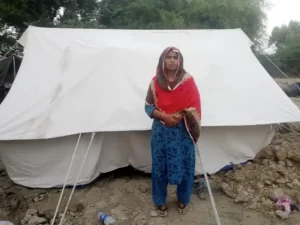
Mugheri, who now lives in a tent with her husband and five children as the floods destroyed her house, wondered how will she rebuild her life.
“I just wish god does not put anybody else through this misery. I often get panic attacks and I remain awake all night,” she said.
“I endured one flood, but this time, things are so much worse, and for us women, things are far more difficult for us.”