
#Karachi residents experience severe #WaterCrisis in #Ramazan
-
People stage protests in many areas over shortages
-
Main supply line affected due to power breakdown
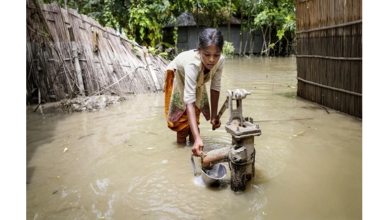
KARACHI: Acute #WaterShortage, coupled with a worst gas crisis and power loadshedding, in several parts of the city has piled agonising miseries on people of Karachi during Ramazan as the water supply from one of the main supply lines of the Karachi Water and Sewerage Board was disrupted due to an abrupt power breakdown on Sunday.
While the short supply of water continued to affect whole of the city, the worst-hit areas were Landhi, Korangi, Qauidabad, Bin Qasim and adjoining neighbourhood after a 72-inch diameter line was affected due to power suspension by the #K-Electric at the Dhabeji pumping station at 11:05am.
In some areas, people also took to streets protesting against the non-availability of tap water in their respective localities where what they called a tanker mafia was reported to have been fleecing people by overcharging.
Enraged residents of Buffer Zone held a demonstration against the water utility in front of the Nazimabad pumping station, chanting slogans and demanding for immediate restoration of water supply to their locality.
They said that their locality had been without a drop of water for the past three weeks and warned that they would hold a protest in front of the #KWSB head office if the water supply was not restored to their area.
A protesting resident, Manzoor Hasan, said that earlier water flowed once a week, but his area was without water for the past many days. “I have to purchase water through small tankers; though it is too hard for me due to financial constraints,” he said.
Residents of several localities, including Gulshan-i-Iqbal, Mohammad Ali Society, Malir, Shah Faisal Colony, Surjani Town, New Karachi, Garden, Saddar, Defence Housing Authority and Clifton said that the water had not been reaching them through taps even before Ramazan.
Some of them alleged that an artificial water crisis had been created in connivance with the water utility staff, which was forcing the citizens of these areas to get water through tankers at much higher prices.
Insiders in the water utility told Dawn that over 550 million gallons of water a day was fed into the city’s main pumping station at Dhabeji for the city that required over 1,100 MGD. They said 40 per cent water was either lost or stolen before it reached consumers.
There are numerous leakages in the supply lines of the water utility that lead to wastage of millions of gallons on a daily basis. Thousands of gallons of water are being wasted for a long time due to multiple cracks in a line for DHA, which is under the administrative control of the Cantonment Board Clifton.
Meanwhile, a spokesman for the water utility said that the restoration work on the 72-inch line affected due to the power breakdown was in progress. He said that the affected line was one of the 10 main lines that supplied water to the city, adding that the affected line led to water shortage in some areas.
He said that the repair work on the affected line would be completed in the next 24 hours and added that water supply to the city continued through alternate lines.
KE claims fault removed swiftly
A spokesperson for the KE confirmed the power breakdown at a KWSB pumping station, but claimed that the power utility removed the fault in 30 minutes.
In a statement, the spokesperson said: “All major KWSB pumping stations including Dhabeji are not only exempt from loadshedding, but alternative supply sources are also available to supply electricity in an emergency situation.
“These measures enabled restoration of power to the KDA pumping station 7 Dhabeji on Sunday following a brief interruption in supply that occurred due to an internal technical fault. The KE staff remained in continued contact with KWSB representatives and swiftly removed the technical fault in 30 minutes,” the spokesperson stated.
Dawn, April 3rd, 2023