
Hopeful Shift: 5 Ways Water-as-a-Service Solar Irrigation in Nepal Is Strengthening Climate-Resilient Farming
Water-as-a-Service solar irrigation in Nepal is emerging as a climate-resilient solution linking clean energy, water security, and sustainable agriculture amid rising climate risks.
Water-as-a-Service solar irrigation in Nepal is gaining momentum at a critical time when climate variability, erratic monsoons, and deepening water scarcity are reshaping the country’s agri-food systems. From drought-prone Terai farmlands to water-stressed hill communities, farmers are struggling to maintain productivity under changing climate conditions.
Against this backdrop, a service-based solar irrigation model is emerging as a promising pathway to strengthen agricultural resilience, reduce emissions, and improve water governance—without placing heavy financial burdens on smallholder farmers.
Understanding Water-as-a-Service (WaaS)
What Makes WaaS Different?
Water-as-a-Service solar irrigation in Nepal shifts irrigation from ownership-based systems to service-based delivery. Instead of farmers purchasing and maintaining expensive solar pumps, private or cooperative service providers install, operate, and maintain systems while farmers pay affordable usage fees.
This model:
- Lowers upfront capital costs
- Ensures technical reliability
- Encourages efficient water use
- Improves long-term sustainability
By separating ownership from access, WaaS allows even marginal farmers to benefit from modern irrigation infrastructure.
Why Solar Irrigation Is Critical for Nepal’s Agriculture
Nepal’s agriculture remains heavily dependent on rainfall, making it extremely vulnerable to climate shocks. Rising temperatures, shrinking glaciers, and unpredictable precipitation patterns are intensifying water stress across farming systems.
Key Climate Pressures Include:
- Delayed and erratic monsoons
- Declining groundwater levels
- Increased drought frequency
- Energy shortages in rural areas
Solar-powered irrigation, when delivered through Water-as-a-Service solar irrigation in Nepal, addresses both water and energy insecurity simultaneously.
IWMI-Led Roundtable Sparks Action-Oriented Dialogue
A recent roundtable consultation co-organized by the International Water Management Institute (IWMI) brought together key stakeholders, including:
- Alternative Energy Promotion Centre (AEPC)
- Renewable Energy Confederation of Nepal (RECON)
- Gham Power
- Sunbridge Solar
This multi-stakeholder dialogue focused on making service-based solar irrigation models technically sound, financially viable, and socially inclusive across Nepal’s diverse agro-ecological zones.
External Link: International Water Management Institute – https://www.iwmi.cgiar.org
Moving Beyond Technology-Centric Approaches
Financial Viability and Inclusive Design
Discussions emphasized that technology alone cannot ensure success. Water-as-a-Service solar irrigation in Nepal must address:
- Affordable tariff structures
- Risk-sharing mechanisms
- Access for women farmers and tenant cultivators
- Local capacity building for maintenance
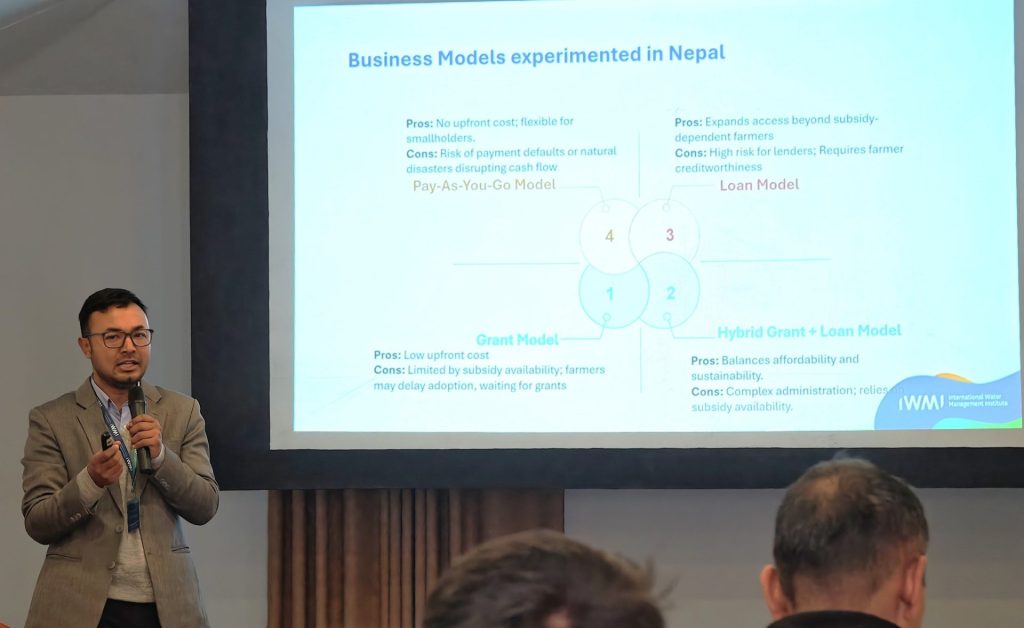
By integrating financial institutions, cooperatives, and local governments, WaaS models can achieve scale without excluding vulnerable communities.
Aligning with Nepal’s National Climate Action Agenda
The roundtable contributes directly to Nepal’s national climate commitments, including:
- Nationally Determined Contributions (NDCs)
- Renewable energy targets
- Climate-smart agriculture strategies
By linking clean energy, water security, and food system resilience, Water-as-a-Service solar irrigation in Nepal supports both adaptation and mitigation goals.
External Link: Alternative Energy Promotion Centre – https://www.aepc.gov.np
Role of the CGIAR Climate Action Program
Insights from the consultation will feed into actionable recommendations under the CGIAR Climate Action Program, which aims to scale climate-resilient solutions across vulnerable regions.
Through evidence-based policy engagement, the program supports:
- Data-driven irrigation planning
- Climate-risk-informed investments
- Scalable public–private partnerships
External Link: CGIAR Climate Action Program – https://www.cgiar.org
Tailoring WaaS Models for Hills and Terai
Context-Specific Solutions
Water-as-a-Service solar irrigation in Nepal must adapt to geographic realities:
In the Terai:
- Larger command areas
- Higher groundwater dependence
- Potential for irrigation cooperatives
In the Hills:
- Lift irrigation systems
- Community-managed schemes
- Smaller but highly efficient solar units
Localized planning ensures equitable benefits and avoids resource overextraction.
Challenges That Still Need Attention
Despite its promise, several barriers remain:
- Regulatory uncertainty for service providers
- Limited access to blended finance
- Weak coordination between water and energy institutions
Addressing these challenges will require policy coherence, clear tariffs, and long-term government support.
The Road Ahead for Climate-Resilient Farming
As climate risks intensify, Water-as-a-Service solar irrigation in Nepal represents a hopeful shift toward sustainable, inclusive, and climate-resilient food systems. By combining innovation, partnership, and policy alignment, Nepal has the opportunity to become a regional model for service-based irrigation solutions.
Conclusion
The transition to Water-as-a-Service solar irrigation in Nepal is not just a technological upgrade—it is a systemic transformation. Anchored in clean energy, equitable access, and climate resilience, this model offers a practical pathway for safeguarding livelihoods, enhancing food security, and meeting national climate goals in an era of uncertainty.