
Pakistan Water Week 2025 – 7 Powerful Signs of a Hopeful Shift Toward a Water-Secure Future
Pakistan Water Week 2025 is already showing powerful, hopeful momentum as policymakers, scientists, and communities collaborate for water security and climate resilience in Pakistan.
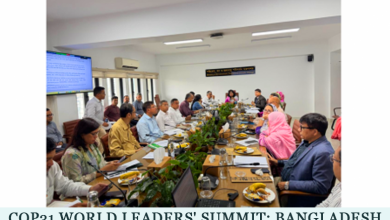
Pakistan Water Week 2025 is off to a powerful and hopeful start. The first two days have gathered policymakers, climate scientists, development partners, donors, water managers, private innovators, academic experts, and communities from across Pakistan — building a collective vision for a resilient, water-secure Pakistan. Across Day 1 and Day 2, the week has shown how research, implementation, equity, climate adaptation, and integrated basin thinking can redefine national water decisions.
This is more than a conference.
This is a turning point — and Pakistan urgently needs one.
Pakistan today has only 900 cubic meters of water per person, as Dr. Rachael McDonnell of IWMI warned. That puts Pakistan below UN water scarcity thresholds. In other words — business-as-usual is mathematically over.
Below is a breakdown of the first two days — and why they matter.
Focus Keyword in Subheading: Pakistan Water Week 2025 and the urgency of water scarcity
Pakistan Water Week 2025 is happening at a moment when Pakistan’s water reality is shifting dangerously.
Climate extremes → more variability.
Population → more demand.
Irrigation → still 90% of water footprint.
Governance → still fragmented.
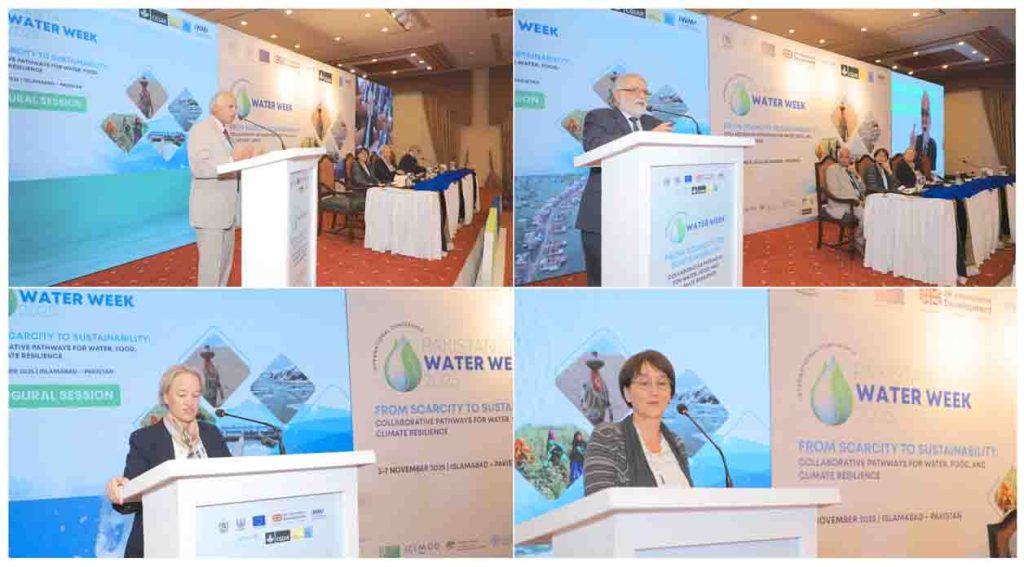
Dr. Claudia Ringler (IFPRI) reminded delegates that Pakistan’s water challenges do not stop at borders — they have global implications. International food prices, cotton/textile value chains, transboundary river negotiations — everything is interconnected.
Day 1: Climate Resilient Pathways
The opening theme of Day 1 was climate resilience planning.
Muhammad Ashraf (IWMI) emphasized that Pakistan’s water is finite.
Finite means mathematical limits.
Finite means innovation is not optional — it is required.
Discussions focused on:
- integrated water accounting
- flood and drought risk modeling
- demand-side management (not just supply)
- aquifer stabilization
- land-water-energy nexus
Chief Guest Mohammad Mohsin Khan Leghari called for:
- more efficient resource use
- improved floodplain mapping
- better coordination across agencies
The message was clear: the climate curve is bending — Pakistan must bend policy along with it.
Day 1: Inclusive Water Governance
Inclusive governance means communities and women must not be “recipients” — they must be decision-makers.
Governance sessions showed that:
- adaptation dies if it is not local
- government policies must be co-designed
- communities are knowledge producers, not knowledge “beneficiaries”
This has implications for WASH, irrigation management, canal farmer organizations, and community groundwater stewardship.
Day 1: Technologies and Innovations
The third Day-1 theme showcased how data and tools change water allocation.
Examples discussed:
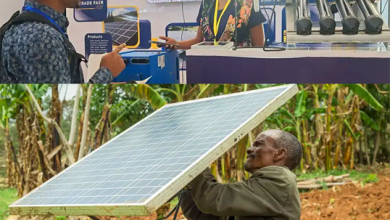
- digital irrigation scheduling
- satellite evapotranspiration mapping
- real-time river data dashboards
- flood early warning systems
- remote groundwater sensing
This is where Pakistan can accelerate the most — because technology compresses time.
Day 2: “Indus and Beyond – Shaping the Next Era of Irrigation in Pakistan”
This session is likely to be talked about long after Pakistan Water Week 2025 ends.
Dr. Marco Arcieri of ICID emphasized nature-based solutions for urban AND rural resilience.
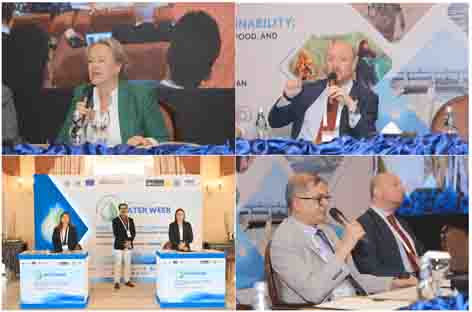
Dr. Mohsin Hafeez (IWMI) focused on irrigation modernization — not just hardware — but data-driven, equitable allocation.
Dr. Johan Gély (IWMI) stressed integrated water management systems that combine:
- basin modeling
- crop water productivity
- groundwater recharge
- digital irrigation
Why this week matters — big picture
If the first two days are the indicator — Pakistan Water Week 2025 is emerging as an inflection point.
Three truths became obvious:
| Insight | Meaning |
|---|---|
| Pakistan’s water scarcity is real | less than 1,000 m³/person |
| Climate is accelerating risk | floods + droughts + heatwaves |
| Innovation is possible and available | Pakistan must adopt, not discuss |
The energy in the rooms — unlike older workshops — was solution-oriented.
Pakistan Water Week 2025 is about movement, not merely messaging.